The Industrial Paint Pigment the EU Banned from Food — That the FDA Still Allows

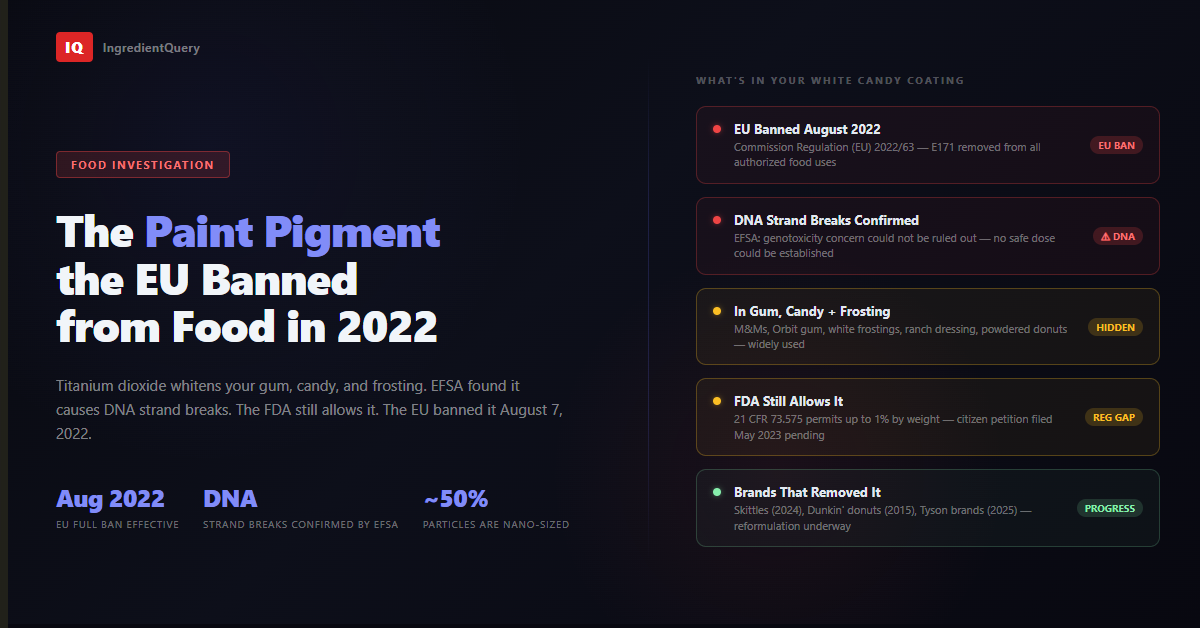
Why the European Union outlawed titanium dioxide in August 2022, what the DNA damage research actually says, and which products it's hiding in.
The ingredient is called titanium dioxide. You probably know it from sunscreen, where it sits on top of your skin and physically blocks UV light. You may have seen it listed on a paint can label.
What you almost certainly don't know is that the same compound has been added to food for decades — to make chewing gum coatings white, powdered donut sugar brilliantly white, candy shells vividly bright, frostings perfectly opaque.
In August 2022, the European Union banned it from food entirely. The European Food Safety Authority concluded it could no longer be considered safe as a food additive due to concerns about DNA damage.
The FDA still allows it.
What It Is and Why It's in Food
Titanium dioxide (TiO₂) has a refractive index of approximately 2.73 — among the highest of any commercially available white pigment. It scatters all wavelengths of visible light equally, producing a neutral, brilliant white. In candy coatings, it transforms a naturally translucent sugar shell into something vividly opaque. In powdered donuts, it makes the sugar dusting look whiter than plain powdered sugar. In frostings, it masks the slight yellowish tint from fats and eggs.
As a food additive in the United States, it's regulated under 21 CFR 73.575 and has been permitted since 1966, at no more than 1% by weight of food.
It has no taste. No smell. No nutritional value. It exists in food purely as an aesthetic agent.
Where It Hides
Candy and confectionery: M&Ms (candy shell), candy corn, Ring Pops, Sour Patch Kids, Trolli gummies, Nerds. Skittles no longer contains it after Mars reformulated in 2024.
Chewing gum: Orbit, Trident White, Extra gum — studies measured 1.1 to 17.3 mg of TiO₂ per piece of gum.
Baked goods: Duncan Hines Whipped Fluffy White Frosting, Betty Crocker white icing products, Hostess Donettes powdered mini donuts.
Condiments: Hidden Valley Fat Free Ranch Dressing, white pasta sauces, some processed cheese products including certain Kraft fat-free varieties.
Medications and supplements: An estimated 91,000 human pharmaceutical products use titanium dioxide as a tablet or capsule coating agent — including products from Centrum, One A Day, Nature Made, and Nature's Bounty.
Why the EU Banned It
In May 2021, EFSA published its re-evaluation and found that "E171 can no longer be considered as safe when used as a food additive."
The central concern was genotoxicity. EFSA found that TiO₂ particles have the potential to induce DNA strand breaks and chromosomal damage. Why couldn't they simply set a safe dose? Five specific reasons:
- No clear correlation between TiO₂'s physicochemical properties and the extent of DNA damage — meaning no "safe version" could be identified
- Multiple parallel mechanisms of DNA damage operating simultaneously
- No threshold dose below which genotoxicity was absent
- No particle size cutoff separating safe from unsafe TiO₂
- Insufficient data to define safe concentrations in tissues
The EU translated EFSA's opinion into Commission Regulation (EU) 2022/63. The ban took full effect on August 7, 2022.
The Nanoparticle Problem
Food-grade titanium dioxide contains a variable fraction of particles smaller than 100 nanometers — the threshold defining a nanoparticle. Studies find this nano fraction ranges from approximately 17% to 54% by particle number in commercial samples.
Nanoparticles behave fundamentally differently from bulk particles. They can be absorbed across the gut epithelium in ways larger particles cannot. Once absorbed, TiO₂ nanoparticles accumulate in organs including the liver, spleen, and kidneys, with estimated tissue half-lives of 200 to 450 days.
EFSA could not identify a safe dose specifically because no particle size cutoff separating safe from unsafe TiO₂ existed in the available evidence.
What the Gut Research Shows
- A 2019 University of Sydney study found that E171 promoted biofilm formation in the gut — a sessile, antibiotic-resistant form of bacterial growth associated with inflammatory bowel disease pathways
- A 2019 study in Nanoscale found TiO₂ nanoparticles shifted gut microbiota composition, reducing Lactobacillus and Bifidobacterium and generating systemic inflammation
- A 2018 mouse model study found E171 downregulated immune surveillance genes and altered cancer-signaling pathways in ways that "could facilitate the development of cancer"
- A 2026 study identified activation of the NLRP3 inflammasome as a specific mechanism, triggering tumor-promoting proteins and accelerating colorectal cancer development in mouse models
The FDA's Position — and the Pressure It's Under
The FDA declined to follow EFSA's 2021 opinion. Its formal position holds that "the available safety studies do not demonstrate safety concerns."
That position faces growing pressure:
- May 2023: Coalition including Environmental Defense Fund, Center for Food Safety, and CSPI filed a citizen petition (FDA-2023-C-1487) requesting revocation of TiO₂'s color additive authorization
- May 2025: MAHA initiative named TiO₂ among food chemicals "of potential concern"; FDA announced accelerated post-market safety review
- Arizona and Texas passed restrictions on titanium dioxide in school meals, effective the 2026–2027 school year
The Skittles Lawsuit — and What Actually Happened
In July 2022, a California consumer filed Thames v. Mars, Inc., alleging Skittles were "unfit for human consumption" due to titanium dioxide. A similar Illinois case followed.
Both were voluntarily dismissed within months — FDA preemption made state consumer protection claims extremely difficult to sustain.
Mars eventually moved anyway. In May 2025, the company confirmed it had removed titanium dioxide from US Skittles by end of 2024 — fulfilling a pledge made to the Center for Food Safety in 2016, nearly a decade late.
Still contains TiO₂: M&Ms (candy shell), most conventional white frostings, many chewing gum brands, Nerds, Ring Pops.
Removed it: Skittles (2024), Dunkin' donuts (2015), Tyson brands announced September 2025.
The Bottom Line
There is no taste benefit. No nutritional benefit. No functional benefit that cannot be achieved with alternative ingredients. Titanium dioxide exists in food for one reason: to make food look white.
The European Union looked at the genotoxicity research, the nanoparticle data, the gut inflammation studies, and concluded that making candy coatings more vividly white is not worth the risk of DNA strand breaks and chromosomal damage — especially when you cannot identify a dose below which the damage does not occur.
Until the FDA acts, the ingredient remains in thousands of American food products. Reading labels is currently the only way to avoid it.
Scan any ingredient label at ingredientquery.com to identify titanium dioxide and other additives banned in other countries but still allowed in US food.