The "No Nitrates Added" Lie on Your Bacon Package

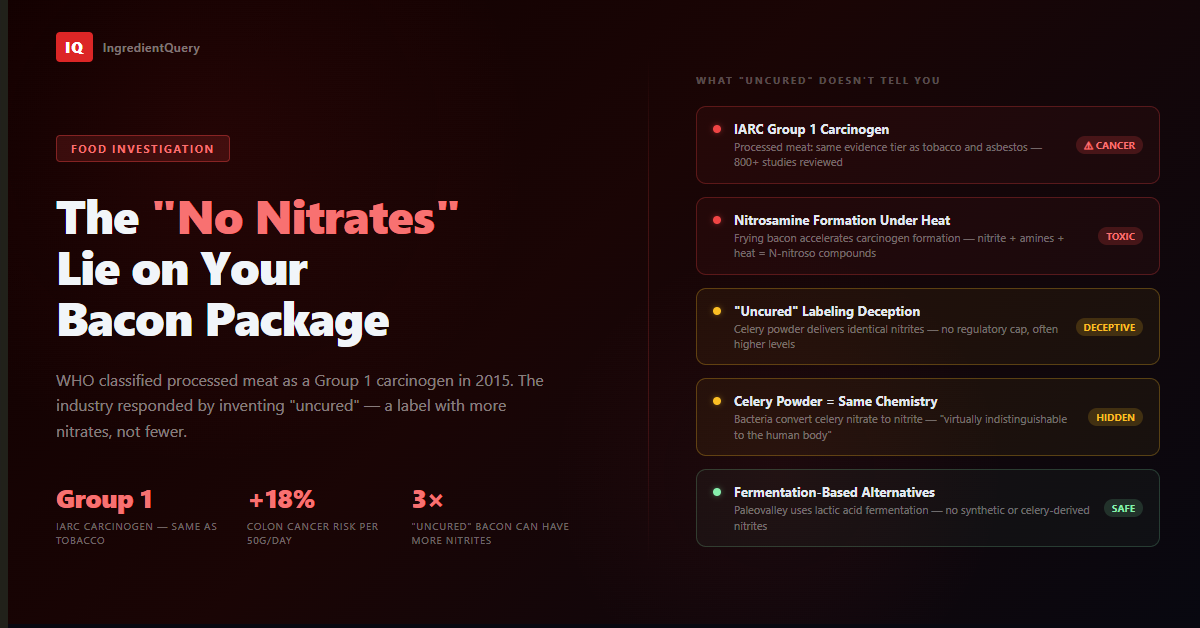
Why "uncured" deli meat often has more nitrates than the regular kind — and how the processed meat industry built a legal loophole out of celery.
In October 2015, the World Health Organization made an announcement that rattled the processed meat industry and confused pretty much everyone else: processed meat is a Group 1 carcinogen.
Group 1. That's the same classification as tobacco and asbestos.
But here's what the announcement didn't cause: people stopped buying bacon. Sales barely moved. The industry went quiet, waited out the news cycle, and eventually pivoted to a new marketing strategy that would prove far more effective than defending sodium nitrate.
They invented "uncured."
What These Compounds Actually Do
Sodium nitrate (NaNO₃) and sodium nitrite (NaNO₂) are related but distinct compounds, and the difference matters.
Sodium nitrite is the active curing agent. It reacts with the myoglobin proteins in meat to produce the characteristic pink-red color of bacon, hot dogs, and ham. Without it, cured meat would turn an unappetizing gray. Nitrite also inhibits lipid peroxidation (rancidity), contributes the distinctive "cured" flavor, and — most critically from a food safety standpoint — inhibits Clostridium botulinum, the bacterium behind botulinum toxin.
Sodium nitrate is a slow-release reservoir: microbes in the meat gradually convert it to nitrite over time, making it most useful in longer-cured products like dry salami or prosciutto.
In products like bacon and hot dogs, manufacturers use sodium nitrite directly. The USDA caps it at 120 parts per million in pumped bacon.
How Nitrites Become Carcinogens
When nitrite enters an acidic environment — and the human stomach maintains a pH between 1.5 and 3.5 — it converts to nitrous acid, then to highly reactive nitrosonium ions. These attack secondary amines naturally present in meat proteins, forming N-nitroso compounds (NOCs) — specifically nitrosamines.
Heating accelerates this reaction dramatically. Frying bacon, cooking hot dogs, grilling sausage — all of these dramatically increase nitrosamine formation before the meat ever reaches your stomach. Nitrosamine concentrations rise measurably with cooking time and temperature.
What the WHO Actually Found
The IARC Working Group that issued the 2015 classification reviewed more than 800 epidemiological studies. Twenty-two scientists from ten countries were involved:
- Group 1 carcinogen — "definitely causes cancer in humans" — specifically colorectal cancer
- Each additional 50 grams of processed meat per day — roughly two strips of bacon or one hot dog — was associated with an 18% increased risk of colorectal cancer
- Approximately 34,000 cancer deaths per year globally attributable to high processed meat consumption
The Celery Powder Deception
After the 2015 WHO announcement, processed meat companies replaced sodium nitrite with celery powder, celery juice concentrate, or celery extract. Celery is naturally one of the highest-nitrate vegetables available. When those celery-derived nitrates come into contact with the bacterial starter cultures used in meat processing, the bacteria convert them to nitrites through the same chemical pathway.
The end chemistry is identical. The human body cannot distinguish nitrite from celery from nitrite from sodium nitrite.
The Numbers Are Worse
Cook's Illustrated ran a laboratory analysis:
- Farmland Hickory Smoked Bacon (conventional): 9.7 ppm nitrite
- Farmland All-Natural Uncured Bacon (same brand): 16.3 ppm nitrite
- Applegate Farms Uncured Sunday Bacon: 35 ppm nitrite — more than three times the level in regular cured bacon
There is no regulatory cap on celery powder quantities, while sodium nitrite in pumped bacon is capped at 120 ppm. The unregulated "natural" route frequently delivers more nitrite than the regulated synthetic one.
The label says "no nitrates or nitrites added." The small print reads "except those naturally occurring in celery powder." Both statements are technically true. Together, they are deeply misleading.
What to Look For on Labels
Synthetic curing agents:
- Sodium nitrite / Sodium nitrate / Potassium nitrite / Potassium nitrate
Vegetable-derived nitrate sources (equally problematic):
- Celery powder / Celery juice concentrate / Celery extract / Celery salt
- Beet powder / Spinach powder
The ascorbate confirmation signal:
- Sodium ascorbate / Sodium erythorbate → almost always means nitrite is also present
Genuinely Nitrate-Free Alternatives
Paleovalley Beef Sticks achieve shelf stability through natural fermentation: a lactic acid starter culture is activated during processing. The bacteria consume the starter sugars during fermentation, producing lactic acid that drops the pH and preserves the product naturally — with no synthetic or celery-derived nitrites.
Other genuinely nitrate-free options: New Primal and Epic, which use similar fermentation-based preservation approaches.
The Bottom Line
The 2015 WHO announcement was accurate. Processed meat is a Group 1 carcinogen. The 18% increased colorectal cancer risk per 50g/day is one of the more consistent findings in nutritional epidemiology.
None of that changed when "uncured" appeared on the label. The chemistry didn't change. The nitrite levels, in many products, went up. Only the language changed.
If you eat processed meat, read the ingredient list rather than the front of the package. Look for the fermentation-based options. And treat "uncured" as a marketing term — not a safety claim — until you've confirmed there's no celery powder hiding in the ingredients.
Scan any ingredient label at ingredientquery.com to flag sodium nitrite, celery powder, and other hidden nitrate sources.