Sold Out: How Big Food Buys Your Trust (Then Sells It Back Cheaper)

You didn't imagine it.
That cereal that used to be different. The soymilk that tasted cleaner. The granola bar your nutritionist recommended — back when it had different ingredients.
You didn't imagine it, because it was different. And the reason it changed is not complicated. It's a playbook. The same moves, executed by the same type of corporation, on the same type of brand, over and over again.
Here's how it works.
Step 1: Find a brand consumers actually trust
Big food corporations are not good at building trust. They're good at acquiring it.
A small brand spends years — sometimes decades — earning loyalty through clean ingredients, honest sourcing, and a founder story. Consumers become fans. Then advocates. Then the brand becomes shorthand for a certain kind of values.
That trust has real dollar value. So a corporation buys it.
Step 2: Pay a staggering amount for the name
Kellogg's bought Kashi in 2000 for $32 million. At the time, Kashi had built a devoted following on whole grains, no GMOs, and "nothing artificial." Kellogg's wanted the loyal consumer, the distribution headroom, and the halo effect — the way "Kashi" made shoppers feel good about a purchase.
They weren't buying a cereal company. They were buying a relationship.
Step 3: Cut what made the product worth trusting
By 2008, Kellogg's manufacturing processes were quietly integrated into Kashi's supply chain. GMO and non-organic ingredients began appearing in products that had never contained them.
Then in 2012, a grocer in Rhode Island tested the products and pulled every Kashi item from his shelves. He found GMO ingredients throughout the line. He posted about it online. The story spread.
Within weeks, a class action lawsuit followed. Consumers alleged Kashi had labeled products "all natural" and "nothing artificial" while containing:
- Pyridoxine Hydrochloride — synthetic B6, produced in a lab
- Alpha-Tocopherol Acetate — synthetic vitamin E
- Hexane-processed soy — extracted using a petroleum solvent
None of these appeared in the original Kashi formulations. All of them appeared after Kellogg's took over.
U.S. retail sales fell 35% between 2010 and 2014. Loyal Kashi customers didn't quit eating granola — they moved to Nature's Path, which grew 43% in the same window. The trust transferred to a brand that hadn't betrayed them.
The Silk Playbook: Quieter, But More Cynical
If the Kashi story was a scandal, the Silk story was something more calculated.
Silk started as an organic soymilk brand. Organic meant the soybeans were grown without synthetic pesticides, fertilizers, or genetic modification. Consumers paid a premium for exactly that guarantee.
Dean Foods acquired Silk's parent company in 2002. For seven years, nothing visibly changed.
Then in 2009, Dean Foods quietly switched the soybeans — from organic to conventional non-GMO. The packaging barely changed. The word "organic" disappeared from the front label, but most shoppers never read the fine print. They'd trusted Silk for years. Why re-read a label you've already vetted?
Organic soybeans cost roughly $7.25 more per bushel than conventional ones. Dean Foods pocketed that difference, multiplied across millions of cartons, while consumers paid the same price they'd always paid — for a product that no longer was what they thought they were buying.
The switch reduced organic soymilk consumption by an estimated 50 million gallons in the first year. Some of that went to other organic brands. A lot of it just vanished — consumers who thought they were drinking organic, because the Silk carton still looked the same.
Who Actually Owns What You're Buying
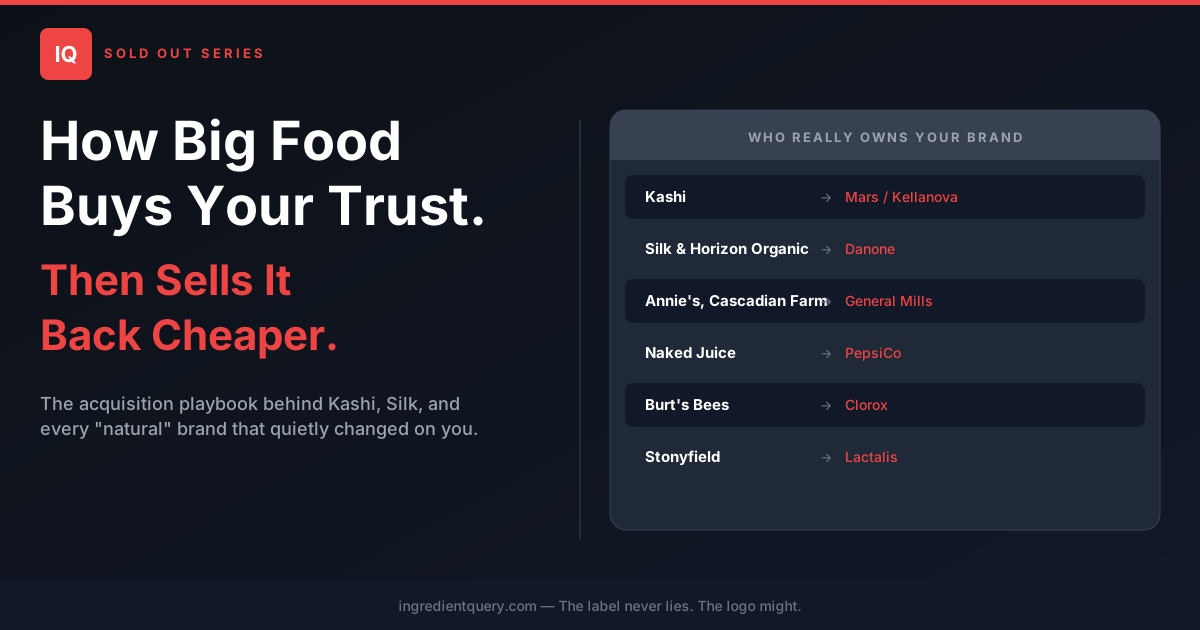
This is the ownership table nobody prints on the box:
| Brand You Trust | Actually Owned By |
|---|---|
| Kashi | Kellanova (acquired by Mars) |
| Silk, Horizon Organic | Danone |
| Annie's, Cascadian Farm | General Mills |
| Naked Juice | PepsiCo |
| Burt's Bees | Clorox |
| Stonyfield | Lactalis |
| Odwalla | Shut down (was Coca-Cola) |
None of these corporations are evil. They are efficient. And efficiency, applied to food, means: what can we substitute, reduce, or remove to improve margin while keeping the logo recognizable?
The logo doesn't change. The ingredient list does.
Why the Label Is the Only Truth
The FDA doesn't require a brand to tell you when an ingredient changes. There's no "reformulation notice" on packaging, no asterisk by the logo, no email to loyal customers. If they update the formula, they update the ingredient list — quietly, in the same small font, on the back of the same box.
Most consumers never notice, because most consumers don't re-read a label they've already trusted.
That's the gap IQ Scanner was built for.
Scan the Kashi box in your cabinet. Run the Silk carton. Check what's actually in the Annie's mac your kid has been eating for three years. Not the brand story. Not the tagline. The ingredient list.
The logo tells you what they want you to believe. The label tells you what's in the box.
→ Scan a label now — no account required
Next in the Sold Out series: Same Box. Less of Everything Good. — the skimpflation playbook, and why your "healthy" product is quietly getting worse every year.