Sold Out: Same Box. Less of Everything Good.

The box hasn't changed.
Same size. Same logo. Same shelf position at the grocery store. Same price — actually a little higher, because everything costs more now.
But the product inside? That changed. Quietly. Without notice. Just an updated ingredient list in the same small font on the back of the same package you've been buying for years.
This is skimpflation: when corporations maintain the appearance of a product while systematically reducing the quality of what's inside it.
It's harder to detect than a price increase. A $0.50 jump on a box of cereal triggers outrage. Silently swapping butter for cornstarch? Nobody notices until someone runs a comparison.
The Annie's Formula Audit
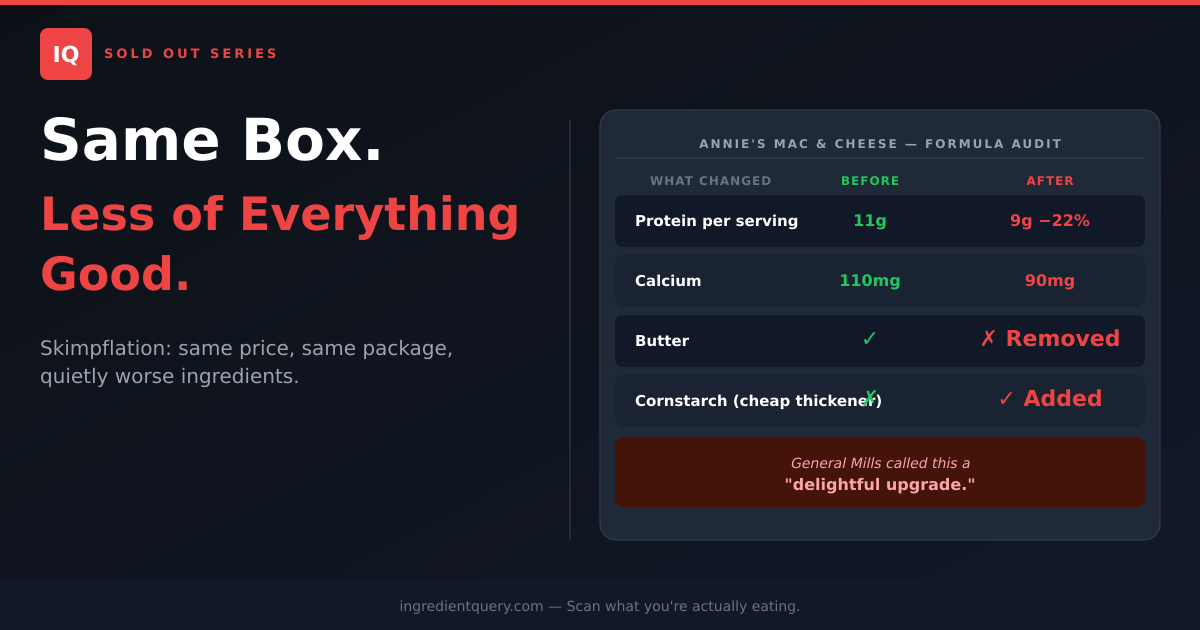
In 2025, General Mills — which acquired Annie's Homegrown for $820 million in 2014 — announced what they called a "delightful upgrade" to their mac and cheese recipe.
Consumers who compared the old and new labels found:
| What Changed | Before | After |
|---|---|---|
| Protein per serving | 11g | 9g (−22%) |
| Calcium | 110mg | 90mg |
| Butter | ✓ In the recipe | ✗ Removed |
| Cornstarch | ✗ Not present | ✓ Added as thickener |
Butter is expensive. Cornstarch is cheap. The result tastes similar enough that most parents don't notice at dinner. The nutrition label tells a different story.
A Change.org petition with thousands of signatures protested the change. Consumer Reports separately flagged that Annie's Organic Cheesy Ravioli contained the highest phthalate concentration of 85 foods tested — phthalates being hormone-disrupting plasticizers that leach from food packaging.
"Delightful upgrade."
The Kashi Collapse
Kashi was once a $600 million brand. Built on whole grains, nothing artificial, no GMOs. Kellogg's acquired it for $32 million in 2000 and spent years integrating its manufacturing processes.
When the ingredient changes came to light in 2012 — synthetic vitamins, hexane-processed soy, GMO ingredients in products labeled "all natural" — the loyal customer base didn't forgive. They didn't argue. They just left.
U.S. retail sales dropped 35% between 2010 and 2014. Nature's Path, an independently owned Canadian brand that kept its ingredient standards, grew 43% in the same period.
The customers who cared most didn't stop eating cereal. They stopped trusting Kashi. The math on skimpflation assumes customers won't notice, or won't act. The ones who do notice act decisively.
Why Skimpflation Is Legal and Common
The FDA doesn't require brands to notify consumers of ingredient changes. There's no "reformulated" label. No asterisk. No requirement to tell the 10 million people who buy your product every year that the thing they think they're buying is different now.
The only disclosure is the ingredient list — same font, same location, updated but not highlighted.
For corporations managing input costs across thousands of SKUs, ingredient substitution is rational. An ingredient that costs $3/lb can often be replaced with one that costs $0.40/lb with minimal impact on flavor or appearance. Multiply that across millions of units and the savings fund an acquisition.
The product gets cheaper to make. The price at shelf doesn't follow.
How to Catch It
The only way to track skimpflation is to read the label — specifically, to compare the label you read today against what the product used to say.
That's harder than it sounds for most consumers. You bought the same box in 2019. You don't have that label anymore.
What you can do:
1. Scan what you actually have. Run your current Annie's box, your current Kashi cereal, your current Silk carton through IQ Scanner. You'll see exactly what's in it today.
2. Look for cheap thickeners in products that shouldn't need them. Cornstarch, carrageenan, modified food starch, and xanthan gum showing up in products that were once straightforward — butter, milk, whole grain — are common skimpflation signatures.
3. Check the protein and fiber. These are the hardest numbers to fake without consumers noticing. A protein drop is often the clearest signal that key ingredients were reduced.
4. Watch for "improved" or "new recipe" language. In the food industry, "delightful upgrade" means costs went down. If the brand is announcing a recipe change, it's worth checking what actually changed.
The Honest Version
Corporations that acquire health brands are not obligated to maintain their standards. They're obligated to their shareholders. Ingredient quality is a cost. When costs get cut, quality is often the first casualty.
The brand story is marketing. The ingredient list is the contract.
A box with a rabbit on it doesn't guarantee the product inside matches what the rabbit represented when you first trusted it.
→ Scan a brand you've been buying for years
Next in the Sold Out series: The MAHA Moment — why the government is finally admitting what health-conscious consumers have been saying for years.