The Sugar Hiding a GMO Secret

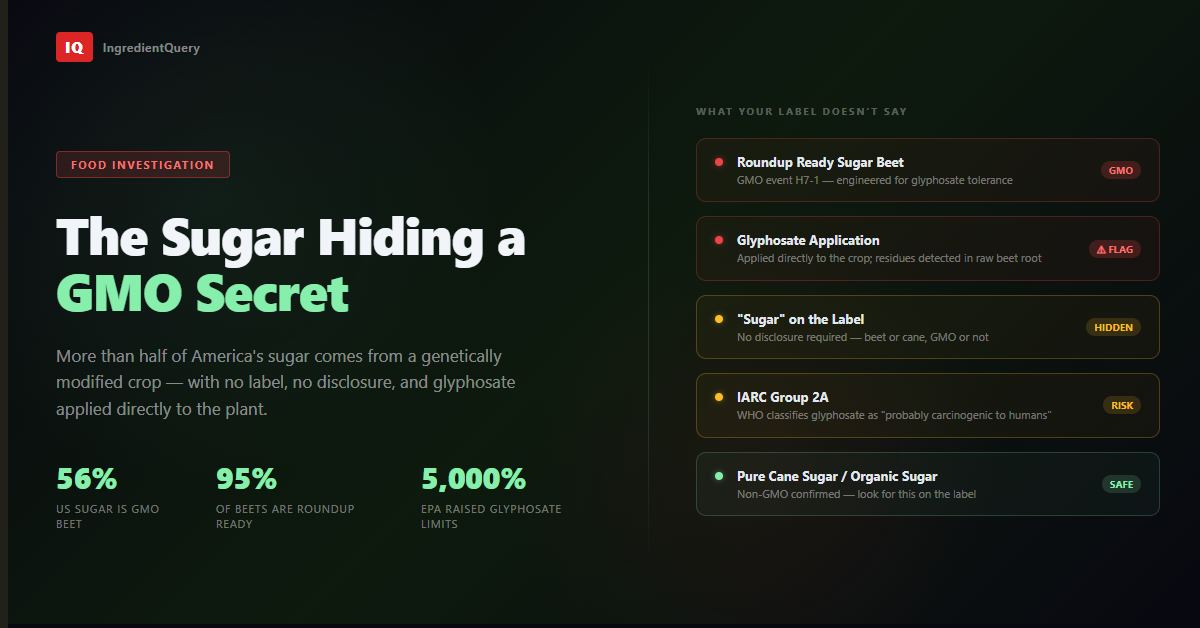
Most people still think GMO food is obvious — like it would say so on the label. It doesn't. And one of the biggest loopholes in the American food system is sugar.
When most people think of GMO foods, they picture corn or soybeans. What almost nobody knows is that the sugar sitting in your pantry — the same sugar in your cereal, your bread, your ketchup — is more likely to come from a genetically engineered beet than from any cane field in Florida or Hawaii.
And unlike every other major GMO crop in the US food supply, there's no way to know by reading the label.
Here's why — and it comes down to a legal loophole built right into how sugar is made.
America's Sugar Is Not What You Think It Is
The United States produces sugar from two sources: sugarcane, grown in Florida, Louisiana, and Hawaii, and sugar beets, grown across the northern plains from Minnesota to Montana and Idaho.
According to the USDA's most recent data, sugar beets now account for 56% of all US domestic sugar production. Sugarcane makes up the remaining 44%.
That alone would be unremarkable — except for one detail. Of all those sugar beets currently in production in the United States, approximately 95% are Roundup Ready. They are genetically engineered to survive direct application of glyphosate, the active ingredient in Monsanto's Roundup herbicide.
Do the math: roughly half of all sugar Americans consume every year comes from a GMO crop engineered specifically to tolerate one of the most controversial pesticides on the planet.
How It Happened — Fast
The story starts in 1998, when Monsanto and seed company KWS Saat petitioned the USDA to approve a new variety of sugar beet: event H7-1. This variety was genetically modified with a gene from a soil bacterium called Agrobacterium tumefaciens, which conferred resistance to glyphosate.
The USDA granted approval. Commercial planting began in 2006 and 2007.
What happened next was remarkable even by GMO adoption standards. Within two years, Roundup Ready sugar beets captured 95% of the US beet market. That kind of adoption speed is almost unheard of — it took other major GMO crops fifteen years or more to reach similar penetration rates.
Farmers loved it. Roundup Ready beets dramatically simplified weed management. Instead of juggling multiple herbicides applied at specific growth stages, growers could spray glyphosate directly over their crop and kill everything around it without harming the beet.
By 2010, Roundup Ready beets were so dominant that when a federal court briefly ordered them deregulated pending an environmental review, the sugar industry lobbied for emergency replanting authorization — arguing that losing GMO beets would devastate the domestic sugar supply. They won. The crop was reinstated. Today, conventional (non-GMO) sugar beet seed is essentially unavailable at commercial scale in the United States.
The Legal Loophole — Why It Doesn't Have to Say GMO
Here's where it gets sneaky.
When Roundup Ready beets are sprayed with glyphosate, the herbicide is absorbed through the leaves and translocated throughout the plant, including into the roots — which is the part that becomes sugar. Studies have measured glyphosate residues in raw sugar beet roots ranging from undetectable up to 8.6 mg/kg.
When GMO beets were approved, the EPA quietly raised the allowable tolerance of glyphosate residue on sugar beet roots from 0.2 parts per million to 10 ppm — a 5,000% increase. Dried sugar beet pulp (used as animal feed) was permitted up to 25 ppm.
Then comes the loophole: when sugar is refined, the DNA gets stripped out. The water-based crystallization process separates sucrose crystals from everything else — including the genetic material and, largely, the glyphosate residues. Studies on finished refined sugar have found glyphosate at or below the limit of detection.
So legally, the finished product no longer has to be labeled as bioengineered. No GMO disclosure. No mention of Roundup. Just "sugar."
That's the loophole. A crop that is 95% genetically modified, grown under direct herbicide application, produces a refined product that clears the legal threshold for GMO labeling — and the consumer has no idea it ever happened.
The transparency argument stands regardless of the residue question: You're buying a product with zero disclosure that it was grown as a GMO crop under a glyphosate program. The refining removes the DNA. It doesn't remove the fact that the entire supply chain was built around it. And you have no ability to opt out, because the label tells you nothing.
The Label That Tells You Nothing
In the United States, sugar labeling is a transparency void.
If a product label says "sugar" with no further specification, it legally could be beet sugar, cane sugar, or a blend of both. Manufacturers change sources seasonally based on commodity prices, and they are not required to tell you.
The only way to know with certainty that you're getting cane sugar is if the label explicitly says "pure cane sugar" or "evaporated cane juice." Those terms are voluntary — companies use them specifically to differentiate themselves from beet-derived product.
What this means in practice: the sugar in most store-brand cereals, mainstream condiments, bulk baking sugar, and packaged snack foods is overwhelmingly likely to be beet-derived, GMO, or a blend — with no disclosure anywhere on the package.
The National Bioengineered Food Disclosure Standard (the US's mandatory GMO labeling law, which went into effect in 2022) does not solve this. Because the genetic modification is removed during refining, beet sugar is not required to carry a "bioengineered" disclosure. The law covers foods with detectable GMO genetic material — refined sugar clears that bar. The loophole is written into the law itself.
What the Science Says About Glyphosate
Whether glyphosate residues survive refining or not, the broader health conversation around glyphosate matters — because it's in the soil, in waterways, in feed crops, and in measurable quantities in human urine across the developed world.
In 2015, the World Health Organization's International Agency for Research on Cancer (IARC) classified glyphosate as "probably carcinogenic to humans" (Group 2A). IARC found strong evidence for genotoxicity — DNA damage — in both pure glyphosate and commercial formulations. It noted a specific association with non-Hodgkin lymphoma in exposed populations.
US and European regulatory agencies (the EPA and EFSA) have pushed back, maintaining that glyphosate at current exposure levels is unlikely to pose a carcinogenic risk. In 2025, an international research consortium released new studies suggesting low-dose glyphosate causes multiple cancer types in animal models — the debate is active and far from settled.
Beyond cancer, independent research has raised concerns about glyphosate's effects on the gut microbiome. Glyphosate inhibits the shikimate pathway — a metabolic process that bacteria use but humans do not — which may allow it to selectively disrupt the bacterial communities in the human gut. Studies in animals show prenatal glyphosate exposure at dietary-relevant levels produced intestinal inflammation, metabolic dysfunction, and elevated homocysteine (a cardiovascular risk marker) across generations.
Regulatory agencies have not accepted these findings as sufficient to change current tolerance limits. But the volume and consistency of independent research pointing toward microbiome disruption is hard to ignore.
Where Beet Sugar Hides in Your Diet
This isn't just about the bag of sugar in your cabinet. "Sugar" as an ingredient appears in thousands of processed foods — and that unlabeled sugar is most likely GMO beet-derived.
Check ingredient labels on:
- Breakfast cereals — even "healthy" varieties often list sugar in the first three ingredients
- Bread and baked goods — virtually all commercial sandwich bread contains added sugar
- Condiments — ketchup, barbecue sauce, sweet pickle relish, and teriyaki sauce are sugar-heavy
- Flavored yogurt — often contains more sugar than a candy bar
- Granola bars and protein bars — "natural" branding doesn't mean cane sugar
- Salad dressings — low-fat versions especially compensate with sugar
- Plant-based meat alternatives — heavily processed and frequently sugar-sweetened
If the label says "sugar" without "cane," you're almost certainly getting beet-derived product.
What to Look For — and What to Buy Instead
If you want to avoid GMO beet sugar, here's what to look for on labels:
- "Pure cane sugar" — confirmed cane, not beet
- "Evaporated cane juice" — confirmed cane
- "Organic sugar" — USDA organic certification prohibits GMO crops, so organic sugar is non-GMO by definition (whether cane or beet)
Brands that explicitly source cane sugar and disclose it:
- Florida Crystals — non-GMO, USA-grown cane sugar
- Wholesome Organic — certified organic cane sugar
- Pure — sources and discloses cane origin
- Zulka — unrefined Mexican cane sugar, widely available
But honestly, the better move is to stop relying on refined sugar entirely.
Swap in real food sweeteners that were never engineered, never sprayed with glyphosate, and never put through an industrial refining process:
- Raw honey — unfiltered, enzyme-rich, naturally antimicrobial
- Medjool dates / date paste — whole food sweetener with fiber, potassium, and antioxidants
- Pure maple syrup — mineral-dense, minimally processed, one ingredient
- Coconut sugar — lower glycemic than cane sugar, retains trace minerals
These aren't just safer alternatives — they're actual food. The body processes them differently than a chemically engineered, industrially refined crystal with no nutritional value and a murky supply chain.
Organic beet sugar does exist: NOW Foods and a few European brands offer certified organic beet sugar — grown without glyphosate, non-GMO by certification. If you see "organic beet sugar" on a label, that's legitimate. The organic certification makes the beet origin meaningful.
What IngredientQuery Scans For
The IngredientQuery scanner flags several common GMO-derived ingredients in the processed food supply — including high-fructose corn syrup (derived from GMO corn), canola oil (98% GMO in North America), and soy lecithin (94% GMO).
The labeling gap around beet sugar is something we're actively addressing. Because refined sugar from both beet and cane sources is chemically indistinguishable, and because labels don't disclose the source, the scanner flags ambiguous "sugar" entries alongside other GMO-risk ingredients — and highlights whether a product is sourcing from transparent, non-GMO suppliers where that information is available.
The goal isn't to alarm. It's to give you the information that the label legally doesn't have to provide.
The Bottom Line
More than half the sugar in the US food supply comes from a genetically modified crop. That crop is grown under routine glyphosate application. The refining process strips out the DNA — which is exactly why it doesn't have to say GMO on the label. That's not an accident. That's the loophole.
The real issue isn't whether your refined beet sugar has a trace of glyphosate in the final crystal. The real issue is that you can't choose. The label doesn't tell you. The law doesn't require it to. And the crop that supplies more than half of American sugar is 95% GMO with essentially no conventional alternative left in commercial production.
Read the label. Reach for cane. Choose organic when it matters to you. And when a label just says "sugar" — now you know exactly what it probably is.
Scan any ingredient label at ingredientquery.com to see what's really in your food.