The Truth About Your Morning Coffee

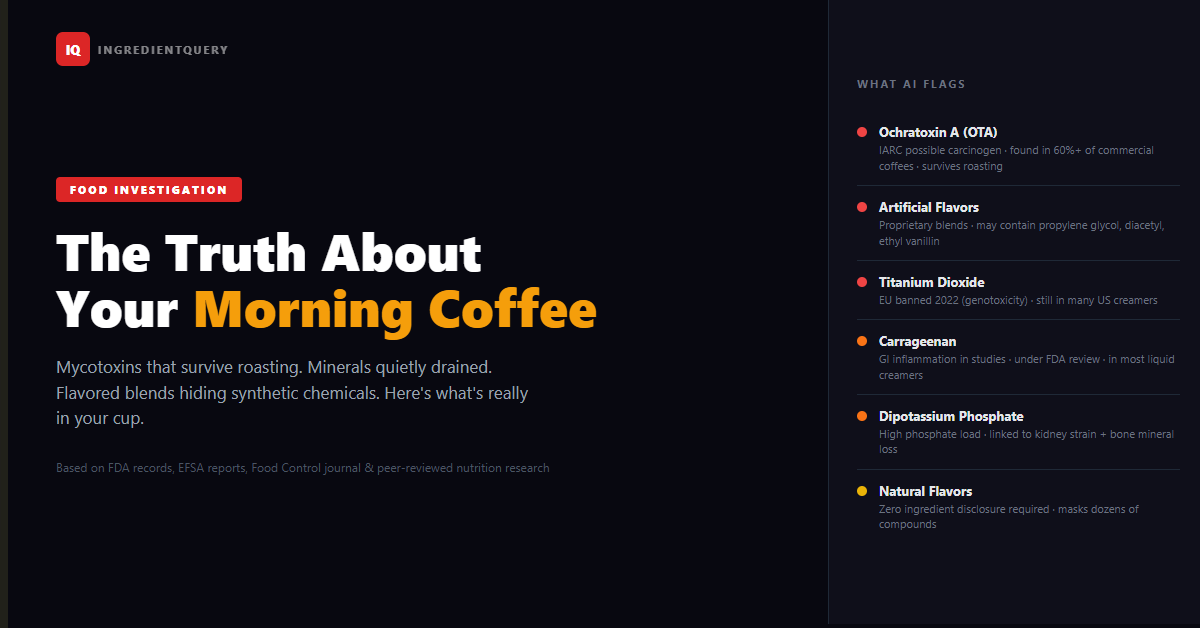
The Truth About Your Morning Coffee
You make it every morning without thinking twice. But that cup of coffee — the one sitting next to you right now — may not be as clean as you think.
We're not here to take your coffee away. Caffeine has real, documented cognitive benefits. Black coffee has antioxidants. The ritual itself is worth something. But the coffee industry has a few secrets it would rather you not know about: invisible mold toxins that survive roasting, mineral losses that quietly compound over time, and flavored coffees loaded with synthetic ingredients that have nothing to do with actual coffee.
Here's what's actually in your cup.
The Mycotoxin Problem Nobody Talks About
Mycotoxins are toxic compounds produced by mold. They form on crops during storage — and coffee beans are one of the most susceptible commodities on the planet.
The two most common in coffee are ochratoxin A (OTA) and aflatoxin B1 (AFB1) — both classified as possible or probable human carcinogens by the International Agency for Research on Cancer.
A 2020 study published in Food Control analyzed 60 commercial coffee samples and detected ochratoxin A in over 60% of them. A separate European Food Safety Authority (EFSA) report found that coffee is one of the top dietary sources of ochratoxin A exposure in adults — ahead of most grains and dried fruits.
Here's the part that surprises most people: roasting does not eliminate mycotoxins. The roasting process reduces OTA levels by roughly 50–80%, depending on temperature and duration, but does not destroy it completely. Lighter roasts, which are trending upward in specialty coffee culture, degrade mycotoxins less than dark roasts.
The risk is highest in:
- Low-quality, commodity-grade coffee — often sold in large cans or bulk bags, grown in humid climates with less quality control
- Pre-ground coffee — more surface area exposed to air and moisture during storage
- Instant coffee — typically made from lower-grade robusta beans and often shows the highest mycotoxin concentrations in studies
- Flavored coffee — flavoring is often added after roasting, and blending masks off-notes that might otherwise signal quality issues
The lowest risk comes from single-origin, high-altitude arabica beans from regions with rigorous quality protocols — and brands that explicitly test for mycotoxins.
What Coffee Actually Does to Your Mineral Levels
Caffeine is a diuretic. That's not news. But most people don't connect that daily diuretic effect to a slow, compounding drain on key minerals.
Magnesium is the main one. Studies consistently show that caffeine increases urinary excretion of magnesium — the most common mineral deficiency in the developed world. Magnesium plays a role in over 300 enzymatic reactions, including sleep regulation, muscle function, blood pressure control, and insulin sensitivity. Two to four cups of coffee a day, every day, without deliberate magnesium replenishment, creates a steady drain.
Calcium is the second. Caffeine inhibits calcium absorption in the gut and increases calcium losses through urine. One study found that each 6 oz cup of coffee offsets absorption of about 4–6 mg of calcium. That's not dramatic in isolation — but at three to five cups per day over months and years, the compounding effect matters, especially for bone density.
Zinc and iron round out the concern. Coffee (and tea) contain polyphenols that bind to non-heme iron, significantly reducing absorption. If you drink coffee within an hour of eating — especially with iron-rich plant foods — you may be absorbing substantially less iron than you think. Zinc absorption is similarly blunted.
None of this means coffee is bad. It means pairing coffee with intentional mineral replenishment — especially magnesium — is not optional for heavy coffee drinkers. It's maintenance.
The Flavored Coffee Trap
Walk down the coffee aisle and you'll see dozens of options: hazelnut, vanilla, caramel, cinnamon roll, birthday cake, peppermint mocha.
These flavors are almost never what they sound like.
Flavored coffees are made by spraying roasted beans with artificial flavor compounds — typically synthesized from petroleum derivatives or wood pulp. The FDA requires that the ingredient list say "natural and artificial flavors" or "artificial flavors," but because flavor formulations are considered proprietary, they don't have to disclose what those flavors actually are.
What hides under "natural flavors" in coffee products:
- Propylene glycol — used as a carrier solvent for flavor compounds; the same ingredient the FDA banned from cat food due to red blood cell damage
- Ethyl vanillin — a synthetic vanillin (imitation vanilla) derived from guaiacol, a petrochemical byproduct
- Diacetyl — a buttery-flavored compound used in microwave popcorn that caused severe lung disease ("popcorn lung") in factory workers exposed to it in large quantities; still used at lower concentrations in some flavored coffees
- Malic acid — a flavor-enhancing acid sometimes used to add tartness or mask bitterness
Beyond the chemicals, flavored coffees almost always start from lower-quality beans. The flavoring masks off-notes that would be unacceptable in unflavored specialty coffee. You're paying for better-tasting cheap beans.
The safe move: get your flavor from what you add to coffee, not from flavored coffee. Add a cinnamon stick. Use vanilla extract (real, not imitation) in your creamer. Buy high-quality beans and notice the natural flavor complexity they already have.
Coffee Creamers: Where It Gets Worse
Black coffee is clean. The problems often start with what goes into it.
Non-dairy creamers — from the powder packets to the refrigerated bottles — are among the most ingredient-dense products in the grocery store:
- Partially hydrogenated oils (trans fats): still legal at sub-0.5g per serving levels in the US, even though the FDA removed them from GRAS status in 2015. Labels can legally say "0g trans fat" while containing them.
- Carrageenan: widely used in liquid creamers as a stabilizer; the same ingredient under FDA review for GI inflammation
- Dipotassium phosphate: a phosphate salt used to prevent separation; at high intakes, phosphate additives are linked to impaired kidney function and accelerated bone mineral loss
- Titanium dioxide: a whitening agent; the EU banned it from food products in 2022 citing genotoxicity concerns; still permitted in the US
- Artificial flavors: again — proprietary, undisclosed, synthetic
The "natural" versions aren't always cleaner. Many use sunflower oil or coconut oil as base fats, which sounds better — but coconut-based creamers are often high in lauric acid, which raises LDL cholesterol. And "natural flavors" in creamers carries the same opacity as anywhere else.
If you use creamer, read the label. The ingredient count alone tells you something. A good creamer has five or fewer ingredients. Most have twelve or more.
The Healthiest Way to Drink Coffee
None of this is reason to quit. Here's what the evidence actually supports:
Go black when you can. The cleaner the coffee, the more the antioxidants (chlorogenic acids, polyphenols) do their job without interference from additive-heavy mix-ins.
Choose high-altitude, single-origin arabica beans. Higher altitude means drier conditions during growth, which means less mold opportunity. Single-origin means you can trace quality back to a source.
Buy whole beans and grind fresh. Pre-ground coffee oxidizes faster, absorbs more moisture, and develops more mycotoxins over the course of its shelf life.
Supplement magnesium if you drink more than two cups a day. Magnesium glycinate or magnesium malate are the most bioavailable forms. 200–400mg daily covers most of what caffeine clears out.
Don't drink coffee within 60 minutes of eating iron-rich foods. The polyphenol-iron binding effect is real. Separate your coffee and your iron by at least an hour.
Consider functional coffee alternatives for at least some of your daily intake. Not as a replacement — but mushroom-based coffees (lion's mane, chaga, reishi) provide a more stable energy curve than straight caffeine alone, without the cortisol spike that high-dose caffeine produces. Several are now low-enough in caffeine that they can supplement a smaller main-coffee intake without triggering the mineral drain at the same rate.
What IngredientQuery Scans For
When you scan a coffee product or coffee creamer on IngredientQuery, our AI flags:
- Carrageenan — GI inflammation risk, under FDA review
- Artificial flavors — transparency flag; proprietary blends, undisclosed compounds
- Propylene glycol — carrier solvent in flavored products; FDA banned from cat food
- Titanium dioxide — EU banned, genotoxicity concerns, still in many US creamers
- Partially hydrogenated oils — trans fat risk even below label threshold
- Dipotassium phosphate — high phosphate load, kidney and bone implications
- Natural flavors — flagged for opacity (proprietary, could mask dozens of compounds)
You can paste the ingredient list from any coffee or creamer directly into the scanner. No barcode required.
The Bottom Line
Coffee isn't the villain. Cheap, contaminated, flavored, heavily-adulterated coffee-adjacent products are the villain.
Know what's in your beans. Know what's in your creamer. Supplement what caffeine takes from you. And if you want to reduce your overall caffeine load without losing the ritual, a mushroom coffee blend once or twice a day — in place of one of your later cups — is one of the more evidence-backed upgrades available right now.
Your morning cup should work for you. It can. Most people just don't know what to look for.
Scan your coffee creamer at ingredientquery.com — paste the ingredient list and get a full breakdown in seconds.