What's Really in Your Dog's Food

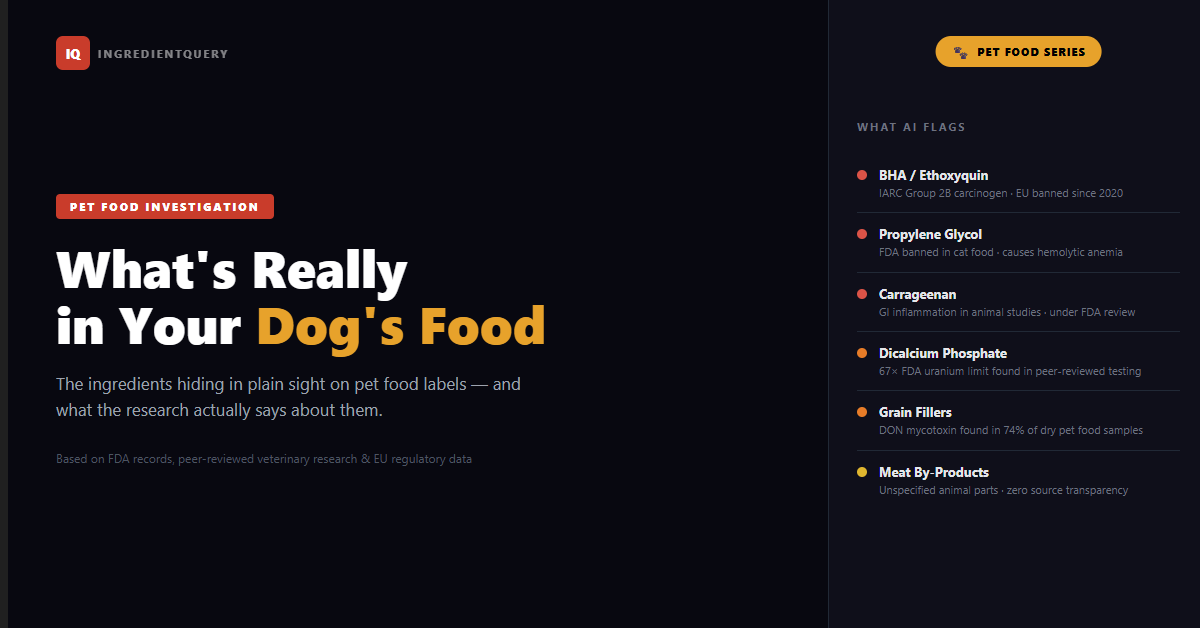
What's Really in Your Dog's Food: The Ingredients Pet Food Companies Don't Want You to Know
You scan the label. You see "chicken," "brown rice," "natural flavors." It sounds wholesome. But dig deeper into the ingredient list — especially the fine print — and a different picture emerges.
We analyzed hundreds of popular pet food labels using AI-powered ingredient scanning. Here's what we found hiding in plain sight.
The Preservative Problem: BHA, BHT, and Ethoxyquin
Walk down any pet food aisle and flip a bag over. Somewhere in the ingredient list — often buried near the end — you'll find one of these: BHA, BHT, or ethoxyquin.
BHA (butylated hydroxyanisole) is classified by the International Agency for Research on Cancer (IARC) as a Group 2B possible human carcinogen. It's used to prevent fats from going rancid. It's cheap. And it's in thousands of pet foods sold in the U.S. today.
Ethoxyquin was originally developed as a rubber stabilizer and pesticide — not a food additive. In 2020, the European Union banned ethoxyquin from all pet food after concerns about its potential to damage DNA and harm the liver and kidneys. In the United States, it remains legal.
BHT (butylated hydroxytoluene) is structurally similar to BHA and raises similar concerns. Studies in rodents link high doses to tumor development. The FDA considers it "generally recognized as safe" at low levels — though critics argue those safe levels were established decades ago using outdated methodology.
The alternative? Natural preservatives like mixed tocopherols (vitamin E) and rosemary extract work just as well and appear on zero carcinogen watch lists. They cost a little more. Which is why many brands don't use them.
Carrageenan: The Additive Under FDA Review
Carrageenan is derived from seaweed. It sounds natural. It is natural. And it's in a surprisingly large number of wet pet foods and cat food pouches — used as a thickener and gelling agent.
The problem: degraded carrageenan (poligeenan) causes inflammation and intestinal lesions in animal studies. While food-grade carrageenan is a different form, researchers have raised concerns that stomach acid can partially degrade it in the digestive tract — converting it into the problematic form.
The National Organic Standards Board voted to remove carrageenan from organic foods in 2016. The FDA is currently reviewing its safety. Many premium pet food brands have already removed it. If it's in your pet's food, it's worth noting.
Propylene Glycol: FDA Banned It in Cat Food — But Not Dog Food
Here's a regulation most pet owners have never heard of: the FDA banned propylene glycol from cat food in 1996 after studies showed it causes a condition called Heinz body formation — a type of damage to red blood cells that leads to hemolytic anemia in cats.
The same ingredient remains legal in dog food.
Propylene glycol is used as a humectant — it keeps semi-moist foods from drying out. If you're feeding a semi-moist or "soft and chewy" dog food or treat, check the label. Cat owners: if you're buying a product not specifically labeled for cats, double-check.
Meat By-Products: What Are They, Really?
"Chicken by-products." "Meat and bone meal." "Animal digest."
These vague terms appear constantly in mid-range and budget pet foods. The AAFCO (Association of American Feed Control Officials) defines meat by-products as "the non-rendered, clean parts, other than meat, derived from slaughtered mammals." That includes lungs, spleen, kidneys, brain, liver, blood, bone, and fatty tissue.
Organ meat isn't inherently bad — liver and kidney are actually nutrient-dense. The problem is the word generic. When a label says "chicken by-products," you know the species. When it says "meat by-products" or "poultry by-products," you don't. The source could change batch to batch with no disclosure.
The real red flag: "animal digest" — a chemically processed liquid or powder made from unspecified animal parts used as a flavor enhancer. When a label says "chicken flavor" and the actual ingredient is animal digest, there may be very little real chicken involved.
Grain Fillers and the Mycotoxin Risk
Corn, wheat, and soy are cheap calorie sources. They're also the primary ingredients in many budget pet foods — often listed as the first or second ingredient, ahead of any protein source.
The deeper issue isn't the grains themselves — it's contamination. A peer-reviewed study published in the journal Animal Feed Science and Technology found deoxynivalenol (DON), a mycotoxin produced by Fusarium mold, in 74% of dry pet food samples tested. Mycotoxin exposure is linked to vomiting, immune suppression, and liver damage in dogs and cats.
Premium brands using human-grade grains or grain-free formulations generally test for mycotoxin contamination. Budget brands often don't publish testing data.
The Heavy Metal No One Talks About
Dicalcium phosphate is a common mineral supplement added to pet food for calcium and phosphorus. It sounds harmless.
A peer-reviewed study published in PLOS ONE tested dicalcium phosphate sourced from bone meal and found uranium concentrations 67 times higher than the FDA's maximum contaminant level for drinking water. Uranium accumulates in the kidneys over time.
This isn't a fringe finding — it was published in a reputable journal, and the researchers called for regulatory review of dicalcium phosphate sources used in pet food manufacturing. To date, no mandatory testing standards exist.
What You Can Do
You don't need to throw out your pet's food. But you do need to read labels — really read them.
A few practical rules:
- Avoid generic "by-products" — "chicken by-products" is acceptable; "meat by-products" is not
- Skip BHA, BHT, and ethoxyquin — look for mixed tocopherols instead
- Check semi-moist foods for propylene glycol, especially if you have cats
- Prefer named protein sources — "chicken," "salmon," "lamb" over "poultry" or "meat"
- Look for NASC or AAFCO-compliant labels with complete nutritional adequacy statements
Better yet: scan the label. Our Pet Food Scanner uses AI to flag every concerning ingredient in seconds — free, no account needed.
Analysis is for informational purposes only and does not constitute veterinary advice. Consult your veterinarian before changing your pet's diet.