Who Really Owns the Supplements in Your Cabinet?

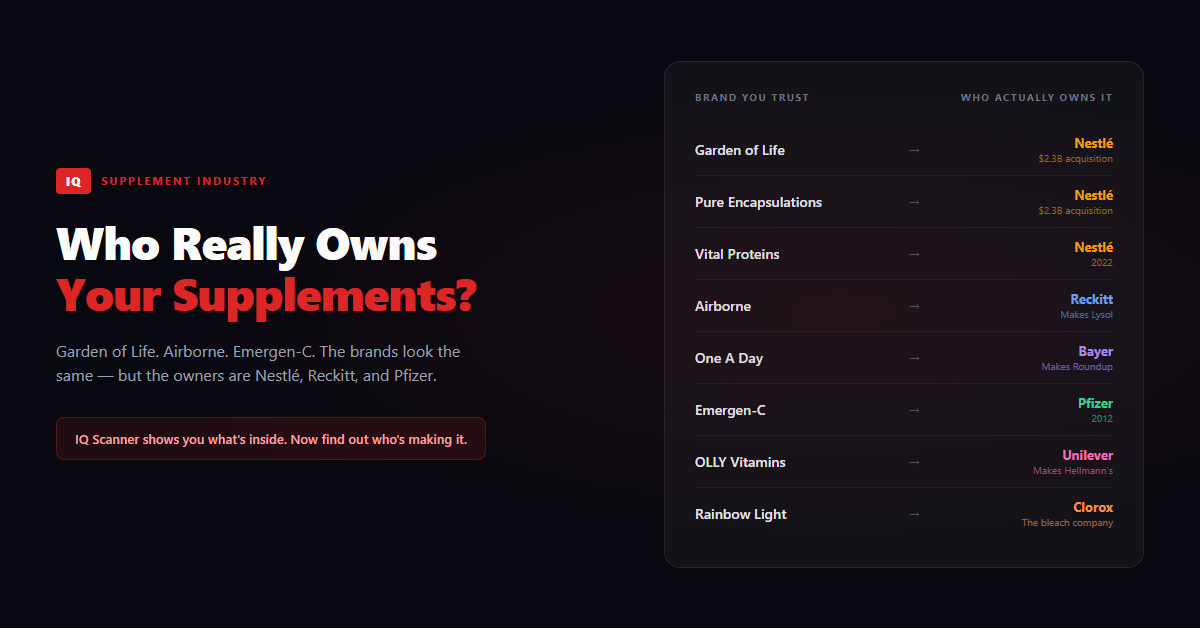
The supplement industry has a dirty secret: most of the brands on health food store shelves are no longer owned by the people who built them.
Over the last two decades, private equity firms and pharmaceutical conglomerates have been quietly acquiring supplement brands — one by one. The logos stay the same. The marketing sounds the same. But the formulations, ingredient sourcing, and manufacturing standards often change after acquisition.
You've probably experienced this without realizing it. A probiotic that used to work stops working. A protein powder you've taken for years suddenly gives you bloating. A vitamin brand you trusted for a decade now has a new "improved formula" — except it's worse.
This isn't coincidence. It's consolidation.
The Acquisition Playbook
When a private equity firm or large corporation acquires a supplement brand, the playbook is predictable:
Year 1: Nothing changes. They keep the founder story, the branding, the community. They need you to not notice.
Year 2–3: Manufacturing contracts get renegotiated. Cheaper suppliers come in. Fillers and flow agents appear in the ingredient list. "Proprietary blends" replace transparent labeling — so you can't see how much of the active ingredient you're actually getting.
Year 4+: The brand becomes a label on a contract-manufactured product made in the same factory as the generic store brand next to it.
The supplement industry has almost no FDA oversight compared to pharmaceuticals. There's no mandatory third-party testing requirement. Labels can say almost anything. And when you're owned by a hedge fund with a 5-year exit timeline, quality is always the first lever to pull.
Who Got Bought
Some of the biggest names in supplements are no longer independent:
Shire/Bayer → Garden of Life — Acquired by Nestlé in 2017 for $2.3 billion. Garden of Life was founded on raw, organic, non-GMO principles. Post-acquisition, Nestlé kept the branding but shifted significant manufacturing to lower-cost facilities.
NBTY / Carlyle Group → Nature's Bounty, Sundown, Osteo Bi-Flex, MET-Rx — NBTY was taken private by private equity in 2010. It owns dozens of supplement brands across the price spectrum — all manufactured with an industrial, cost-reduction-first approach.
Unilever → OLLY, SmartyPants — Both were wellness darlings. Both acquired by one of the world's largest consumer goods companies.
Nestlé → Vital Proteins — The collagen brand that built its following on clean, grass-fed sourcing was acquired in 2021. The "Collagen Shots" line that followed contains a fraction of the collagen content in the original product.
Church & Dwight → Vitafusion, L'il Critters — Yes, the company that makes Arm & Hammer baking soda and Trojan condoms also owns your gummy vitamins.
The pattern repeats: founder sells, quality degrades, consumers get fooled by brand equity they built trust in years earlier.
What Independent Still Looks Like
The brands that haven't sold out tend to share a few traits: founder-led or family-owned, direct-to-consumer primary channel, obsessive about sourcing and third-party testing, and transparent about everything.
Here are the brands we actually trust — and where to find them:
Myoxcience
Founded by Mike Mutzel (High Intensity Health), Myoxcience is one of the few supplement brands where the founder has a PhD, publishes research, and personally takes everything they sell.
Their standouts: NAC Glycine Supreme (NAC + Glycine + Taurine for glutathione support), Berberine Fasting Accelerator (clinically dosed for blood sugar), and Optimized Magnesium Glycinate (the most bioavailable magnesium form, no fillers).
No artificial dyes, no flow agents, no magnesium stearate filler. Every formula is built around the published research.
→ Browse the full Myoxcience store on Amazon
Paleovalley
Still founder-led, still making products the hard way. Their grass-fed beef sticks are fermented — no synthetic nitrates, no seed oils, no fillers. Their Superfood Bars have 9g of protein per bar with zero artificial dyes and zero refined sugar, in a snack bar market absolutely dominated by seed oils and corn syrup.
What makes Paleovalley different: they actually care about what doesn't go in. Most supplement and snack brands compete on what they add. Paleovalley competes on what they remove.
→ Browse the full Paleovalley store on Amazon
Lineage Provisions
A small-batch brand that sources everything from regenerative farms. Their grass-fed collagen powder is unflavored, unsweetened, and made from a single ingredient. No "natural flavors," no stevia, no proprietary blends — just collagen.
Their air-dried beef steak bites are the clean meat snack equivalent: beef and sea salt. That's the entire ingredient list.
→ Browse the full Lineage Provisions store on Amazon
Global Healing
Founded by Dr. Edward Group, Global Healing has been making clean supplements since 1998. They use a proprietary manufacturing process called Raw Herbal Extract™ that preserves the full spectrum of phytonutrients without harsh extraction methods.
Their Liver Health formula (organic milk thistle + dandelion root) and Oxy-Powder colon cleanse are staples if you're doing any kind of detox work — especially relevant after years of consuming processed foods loaded with synthetic preservatives.
→ Browse the full Global Healing store on Amazon
MUD\WTR
Not a supplement brand exactly — but worth including here because they occupy the same shelf space as conventional coffee and energy drinks, which are dominated by synthetic additives, artificial flavors, and fillers.
MUD\WTR's original mushroom blend is USDA Organic, uses real USA-grown mushrooms (not mycelium filler on rice), and has 1/7th the caffeine of a cup of coffee. It's what your morning ritual looks like when the supplement industry hasn't gotten to it yet.
→ Browse the full MUD\WTR store on Amazon
MASA Chips
Not supplements — but the snack food aisle is the supplement aisle's cousin in terms of corporate consolidation. Virtually every chip brand is now owned by PepsiCo (Frito-Lay), Mondelez, or Kellogg's, and virtually all of them are cooked in seed oils.
MASA Chips are made from nixtamalized corn, sea salt, and grass-fed beef tallow. Three ingredients. No canola, no sunflower, no "vegetable oil blend." They're what chips were before industrial food production turned them into a delivery vehicle for seed oils and sodium.
→ Browse the full MASA Chips store on Amazon
LesserEvil
For the snack category, LesserEvil is doing what MASA does for chips — making organic snacks with clean oils (coconut, avocado) and zero synthetic dyes. Their Himalayan Gold Salt organic popcorn is a direct swap for the conventional flavored popcorn aisle, which is almost entirely made with seed oils and artificial flavoring.
→ Browse the full LesserEvil store on Amazon
Go Raw
Go Raw is the sprouted seed and granola brand in a snack aisle full of products pretending to be clean. Their Sweet & Salty Snacking Granola is organic, sprouted, and made without vegetable oils or refined sugar — unusual in a category where most "healthy" granolas have canola oil and cane syrup in the first five ingredients.
→ Browse the full Go Raw store on Amazon
How to Tell Who Still Owns What They Sell
A few quick checks before you trust a supplement brand:
1. Look up the parent company. Search "[Brand name] parent company" or "[Brand name] acquisition." If a PE firm or a Fortune 500 food company shows up, be skeptical.
2. Check the address on the label. If a "small batch" brand lists a fulfillment center in New Jersey or a PO box in New York, they're not making what they're selling.
3. Look for a real founder. Not a stock photo CEO. A person with a name, a face, and a track record before this company existed.
4. Check the ingredient list — not just the front panel. "Organic" on the front doesn't tell you anything about fillers, flow agents (magnesium stearate, silicon dioxide), or synthetic B vitamin forms (cyanocobalamin vs methylcobalamin).
5. Look for third-party testing certifications. NSF Certified for Sport, Informed Sport, or USP Verified are meaningful. "Lab Tested" on the label from a lab the company owns means nothing.
The Scanner Can Help
If you want to check what's actually in a product before you buy it, the IQ Ingredient Scanner will flag the specific ingredients to watch for — synthetic preservatives (BHA, BHT, TBHQ), seed oils, synthetic dyes, sugar aliases, and more.
Scan any food or supplement label. You'll know in 10 seconds whether you're getting what the front of the package promises.