BHT, BHA, TBHQ: The Preservatives in Everything

Open your kitchen cabinet. Pull out any packaged snack — crackers, cereal, chips, a granola bar. Flip it over.
Somewhere in that ingredient list, there's a good chance you'll find three letters: BHT. Or BHA. Or TBHQ. Maybe all three.
These are synthetic antioxidant preservatives. Their job is to prevent oils and fats from going rancid — to extend the shelf life of food that would otherwise spoil in days into food that lasts months or years. They are extraordinarily effective at that job.
They're also banned in several countries that decided the evidence warranted caution.
Here's what they are, where they hide, and what the science actually says.
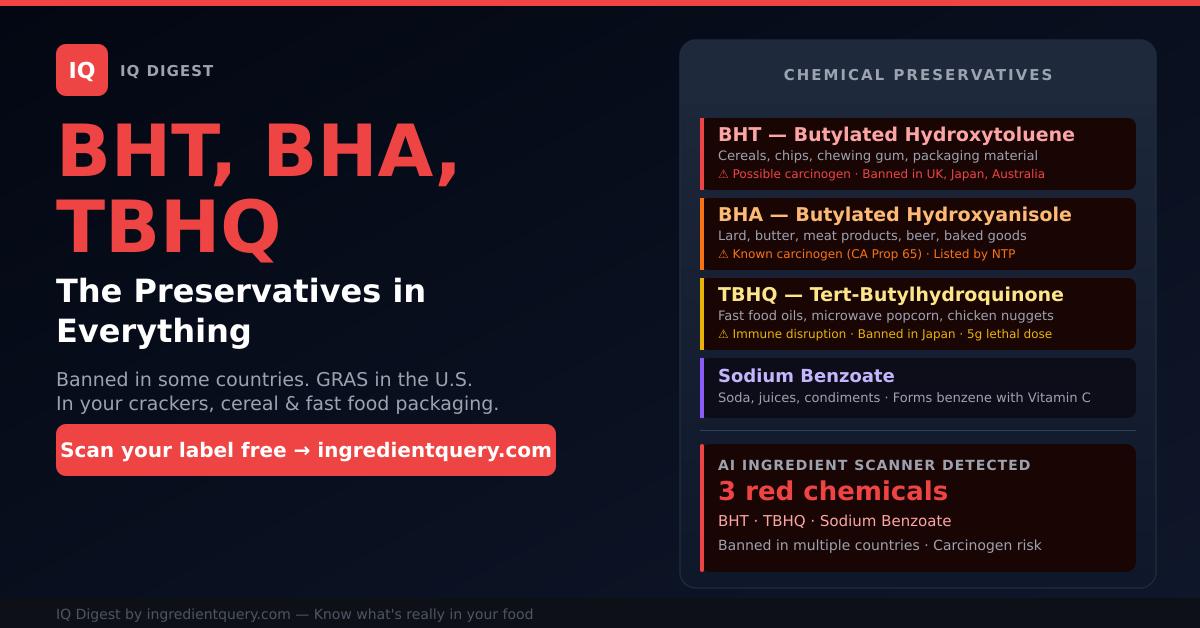
BHA — Butylated Hydroxyanisole
What it is: A waxy, white solid derived from petroleum. Added to fats, oils, and fat-containing foods to prevent oxidation.
Where it hides: Lard, butter, meat products, beer, baked goods, breakfast cereals, snack foods, dehydrated potatoes, chewing gum.
What the research says:
BHA is listed as a known human carcinogen by California's Proposition 65. The National Toxicology Program (NTP) classifies it as "reasonably anticipated to be a human carcinogen" based on studies showing it caused forestomach tumors in rats, mice, and hamsters.
The FDA still classifies BHA as GRAS — Generally Recognized As Safe. The agency's position is that the tumors observed in rodents occur in a forestomach that humans don't have, making the relevance to human cancer risk uncertain.
Japan restricts BHA. The European Union permits it at very low levels with ongoing review.
BHT — Butylated Hydroxytoluene
What it is: Chemically similar to BHA, also petroleum-derived. Used in both food and industrial applications — BHT is also used as a jet fuel additive and in rubber products.
Where it hides: Breakfast cereals, chips, chewing gum, shortening, vegetable oils, instant potatoes, frozen sausage — and notably, in food packaging itself, where it migrates into the food.
What the research says:
BHT's safety record is more contested than BHA's. Some studies show it acts as a tumor promoter; others suggest it may actually inhibit certain cancers. The National Toxicology Program found it caused liver and lung tumors in some animal studies.
The United Kingdom, Japan, Romania, Sweden, and Australia have banned or restricted BHT in food. In the U.S. it remains GRAS.
One detail worth noting: BHT is often added to packaging material rather than directly to food — which means it doesn't always appear on the ingredient label at all, even though it ends up in the food you eat.
TBHQ — Tert-Butylhydroquinone
What it is: Another petroleum-derived antioxidant, often used in fast food oils and products with high fat content.
Where it hides: Fast food frying oils, microwave popcorn, chicken nuggets, crackers, cooking sprays, certain frozen foods. TBHQ became widespread after partially hydrogenated oils (trans fats) were phased out — the replacement oils spoil faster and need more preservatives.
What the research says:
TBHQ is the most concerning of the three by several measures:
- A 2020 report from the Environmental Working Group found TBHQ may impair immune response, specifically interfering with T-cell function in a way that could reduce the effectiveness of flu vaccines.
- At high doses, TBHQ causes precancerous stomach tumors in animals.
- The lethal dose for humans is estimated at 1–4 grams per kilogram of body weight — meaning about 5 grams could be lethal for an average adult. (Permitted food levels are a tiny fraction of this, but it illustrates the compound is not inert.)
- Japan bans TBHQ in food entirely. The EU permits it at very low levels.
Despite this, TBHQ is FDA GRAS and appears in hundreds of popular products.
Sodium Benzoate: The Bonus Preservative
While not in the same chemical family, sodium benzoate deserves mention alongside the others because it shows up in many of the same products.
Sodium benzoate is used as a preservative in acidic foods — sodas, fruit juices, pickles, condiments. On its own, the FDA considers it safe.
The problem: when sodium benzoate comes into contact with vitamin C (ascorbic acid) — which is commonly added to the same beverages — the two compounds react to form benzene, a known human carcinogen linked to leukemia.
This reaction is most likely to occur in drinks stored at high temperatures or exposed to light. Diet sodas (which often contain both sodium benzoate and added vitamin C) have been found to contain measurable benzene levels in testing by the FDA and independent researchers.
The fix is simple: don't combine sodium benzoate with vitamin C in a product. Many manufacturers have reformulated. Many haven't.
The GRAS System: How These Stay in the Food Supply
All of these preservatives have one thing in common: they are classified as GRAS by the FDA.
GRAS — Generally Recognized As Safe — sounds rigorous. It isn't always. The GRAS designation was created in 1958 for substances with a long history of safe use. Over time it evolved into a system where companies can self-certify their own ingredients as GRAS, using their own studies, without mandatory FDA review.
An investigation by the Government Accountability Office found that the FDA is often unaware of GRAS determinations — meaning ingredients can enter the food supply legally without the FDA ever evaluating them.
BHT, BHA, and TBHQ were all added to the GRAS list decades ago, based on science from that era. Updating or removing a GRAS designation requires the FDA to affirmatively act — which rarely happens.
A Pattern Worth Noticing
The same preservatives banned in Japan and parts of Europe remain GRAS in the United States. This isn't because the U.S. has better science — the studies are largely the same. It's because regulatory systems weight evidence differently, apply different standards for the burden of proof, and face different industry pressures.
The EU and Japan tend toward a precautionary approach: if there's credible evidence of harm at any dose, restrict or ban until proven safe at permitted levels. The U.S. tends toward the opposite: permit until harm is clearly established at consumption levels.
Neither system is perfect. But it's worth knowing which one governs your grocery store.
How to Avoid Them
These preservatives are required to be listed by name on ingredient labels — so they're findable if you look.
Search for: BHA, BHT, TBHQ, sodium benzoate.
Products least likely to contain them: fresh foods, refrigerated items with short shelf lives, products from brands that explicitly market as "no artificial preservatives," and products formulated for European markets (which require reformulation to remove them).
The simplest version: if a cracker can sit in your pantry for two years without going stale, ask yourself what's making that possible.
A brand with zero BHA, BHT, or TBHQ across their entire product line: Primal Kitchen makes condiments and sauces shelf-stable through natural acidity and clean fat sourcing rather than petroleum-derived antioxidants. Use code IQ$PK89F10 for 10% off at primalkitchen.com.
Scan any food label free at ingredientquery.com — our AI flags BHT, BHA, TBHQ, and sodium benzoate instantly.