C15:0 and Heart Health: What the Observational Data Actually Says
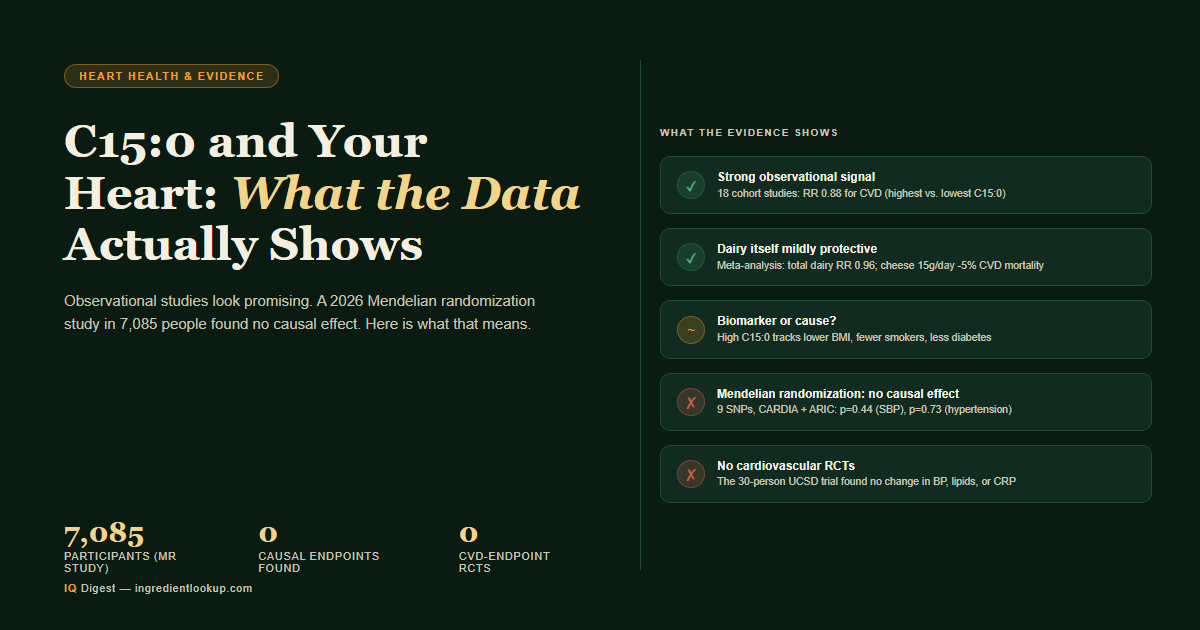
Observational studies consistently link higher C15:0 to lower cardiovascular risk. A 2026 Mendelian randomization study in 7,085 people found no causal effect. Here is what that distinction means.

If you follow nutrition research, you have probably seen headlines about C15:0 and heart health: "odd-chain fatty acid linked to lower cardiovascular disease risk," "dairy fat biomarker tied to better heart outcomes." The studies behind those headlines are real. But a critical piece of context almost always gets left out -- and it changes the meaning of the evidence significantly.
Here is a careful look at what the data actually shows, what it cannot show, and what the strongest causal test available says about C15:0 and your cardiovascular system.
The Observational Signal Is Real -- and Genuinely Interesting
Multiple large, well-designed studies have found that people with higher circulating C15:0 tend to have better cardiovascular outcomes. This is not a fringe finding.
A meta-analysis of 18 prospective cohort studies (n=42,736, 11,950 CVD cases, published in PLOS Medicine) found that participants in the highest tertile of circulating C15:0 had a relative risk of 0.88 compared to the lowest tertile -- a 12% lower CVD risk. A Swedish cohort study (n=4,150, median 16.6-year follow-up) found a hazard ratio of 0.75 per interquintile range for incident CVD -- a substantial association. A pooled analysis of EPIC-CVD, UK Biobank, and INTERVAL (~172,891 participants), published in the European Journal of Preventive Cardiology, found that odd-chain saturated fatty acids (C15:0 and C17:0 combined) were associated with lower coronary heart disease risk (HR 0.82) and lower stroke risk (HR 0.73).
In the CARDIA cohort specifically, each standard deviation increase in plasma C15:0 was associated with 1.47 mm Hg lower systolic blood pressure and 1.13 mm Hg lower diastolic blood pressure. That is a meaningful difference at a population level.
So: across multiple large, independent datasets, higher C15:0 tracks with better cardiovascular outcomes. The signal is real and consistent.
But Observational Studies Cannot Establish Cause
The critical question is: does higher C15:0 improve cardiovascular health, or does C15:0 simply track other things that improve cardiovascular health?
C15:0 is primarily found in full-fat dairy and fatty ruminant meat -- foods that tend to be consumed by people with certain dietary patterns. People who eat more full-fat dairy often differ from those who don't in ways that matter for heart health: they may have higher overall diet quality, lower sugar intake, different BMI trajectories, different exercise habits. Separating the C15:0 effect from the diet-pattern effect is genuinely difficult with observational data.
The CARDIA study illustrates the confounder problem directly. In that cohort, participants with the highest plasma C15:0 also had significantly lower waist circumference, lower rates of diabetes, and fewer current smokers -- all independent and powerful determinants of cardiovascular risk. After careful statistical adjustment, the blood pressure associations shrank. And even adjusted, the residual confounding from factors not measured or not measurable cannot be ruled out.
This is not a flaw unique to C15:0 research. It is the fundamental limitation of nutritional epidemiology. Foods come in packages -- dietary patterns, food matrices, socioeconomic correlates -- and statistical adjustment can only go so far.
The Mendelian Randomization Study: The Best Causal Test Available
Mendelian randomization (MR) is the most rigorous method short of a randomized controlled trial for testing whether an exposure causes an outcome. The idea: use genetic variants that are known to raise or lower circulating C15:0 as a natural experiment. People who inherit these variants have slightly higher C15:0 regardless of their lifestyle -- so comparing their cardiovascular outcomes to people with lower-C15:0 genotypes can isolate the effect of C15:0 itself from all the dietary and lifestyle confounders that plague observational studies.
A 2026 study from the University of Minnesota, published in Frontiers in Nutrition, did exactly this using data from CARDIA (n=3,196) and ARIC (n=3,889). Using nine genetic variants associated with plasma C15:0, the authors ran two-sample Mendelian randomization analyses against every cardiovascular endpoint available in their data.
The results: no causal effect on systolic blood pressure (p=0.44), diastolic blood pressure (p=0.57), resting heart rate (p=0.19), hypertension risk (p=0.73), or incident cardiovascular disease events in either cohort.
The authors' own conclusion: "The collective evidence is not consistent with a cardiovascular benefit of C15:0." They interpret the observational associations as evidence that C15:0 is "a biomarker of healthier lifestyle and metabolic status rather than a biologically active determinant" of cardiovascular health.
This is a significant finding. It does not mean C15:0 is harmful -- it almost certainly is not. But it suggests that the inverse associations seen in observational studies reflect what C15:0 tracks (full-fat dairy consumption, associated dietary patterns, the characteristics of people who eat that way) rather than what C15:0 does.
What About the Dairy Itself?
The distinction here matters: even if C15:0 is not the causal agent, the foods that contain it may still be beneficial. And the evidence on full-fat dairy and cardiovascular disease is more favorable than many people expect.
A recent meta-analysis found total dairy associated with a small but statistically significant CVD risk reduction (RR 0.96, 95% CI 0.93-0.99). A 29-cohort prospective analysis (n=1,680,651) found cheese at 15 g/day linked to a 5% lower CVD mortality risk (HR 0.95). Total dairy intake appears to follow a roughly U-shaped dose-response curve, with the modest inverse association peaking around 250-300 g/day.
These are observational data too, and the effect sizes are small. But they are consistent with the idea that full-fat dairy -- as a food -- is not the cardiovascular threat it was assumed to be in the low-fat dietary era. The benefit, to the extent it exists, likely comes from the full food matrix: vitamin K2 in aged cheese, probiotics in fermented dairy, the specific fatty acid profile of ruminant fat as a whole.
C15:0 may be the best measurable marker of that dietary pattern, without being the driver.
No Randomized Controlled Trials on Cardiovascular Endpoints
The only randomized trial of C15:0 supplementation in humans with any cardiovascular-adjacent measurements is the 30-person UCSD trial that Fatty15 funded. It found no significant changes in total cholesterol, LDL, blood pressure, or C-reactive protein over 12 weeks. No RCT has been designed or powered to test incident cardiovascular disease, heart attack, or stroke as an endpoint. That would require thousands of participants and years of follow-up -- none of which exists.
The 2025-2030 U.S. Dietary Guidelines still recommend limiting saturated fat to less than 10% of daily calories for cardiovascular health. The ACC has not issued guidance specific to odd-chain saturated fatty acids. The institutional consensus remains: saturated fat as a category raises LDL cholesterol, even though the dairy-specific evidence is more nuanced, and even though replacing saturated fat with refined carbohydrates does not appear to improve cardiovascular outcomes.
How to Read the Evidence Tier
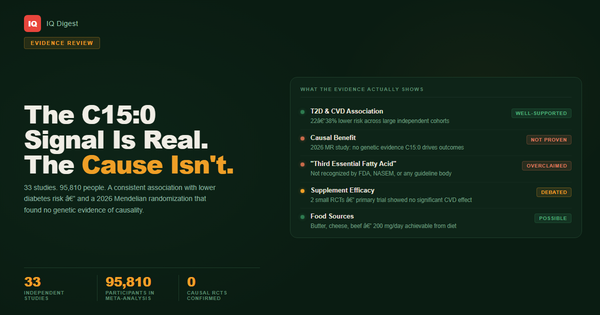
Well-supported: C15:0 is consistently and inversely associated with cardiovascular risk markers and outcomes across large observational studies. This association is real and replicable.
Plausible but debated: Whether C15:0 is a causal cardioprotective agent, or whether it primarily functions as a biomarker of a dietary pattern that happens to be associated with better heart health. The Mendelian randomization evidence leans against causality, but a single MR study is not the final word.
Not supported: That supplementing C15:0 will improve your cardiovascular outcomes. No trial exists to support this claim. The marketing language around C15:0 and heart health runs substantially ahead of what the evidence can bear.
The Practical Takeaway
The most honest reading of the current evidence: eating full-fat dairy is likely neutral to mildly beneficial for cardiovascular health in the context of an otherwise reasonable diet, and C15:0 is the best blood biomarker of that dietary pattern. Whether the fatty acid itself is doing any of the work remains genuinely uncertain -- and the most rigorous causal test available says it probably is not.
If you eat full-fat dairy and want to know where your C15:0 stands relative to the research range, the C15 Intake Calculator gives you a food-based estimate. If you are specifically trying to optimize cardiovascular health, the bigger levers remain the ones with decades of RCT support: exercise, smoking cessation, blood pressure management, and overall diet quality.
C15:0 is a genuinely interesting fatty acid. It may turn out to have real effects that current trials are underpowered to detect. But "interesting biomarker with a consistent observational signal" is not the same as "proven cardioprotective agent" -- and being clear about that difference is what honest nutrition reporting requires.
This article is for general education, not medical or dietary advice. Sources: CARDIA/ARIC Mendelian Randomization (Frontiers in Nutrition, 2026) | Trieu et al. meta-analysis (PLOS Medicine, 2021) | EPIC-CVD odd-chain SFA analysis (European Journal of Preventive Cardiology, 2025) | Swedish cohort biomarker study (PMC, 2021) | Primary Fatty15 RCT (PMC, 2025)