Can You Hit 200 mg of C15:0 From Food Alone?
The 200 mg/day C15:0 target is everywhere — but what does it actually take to reach it from food? We break down per-serving data, the grass-fed multiplier myth, and why the target itself is shakier than it looks.

If you've read anything about pentadecanoic acid (C15:0), you've seen 200 mg/day cited as the intake target. Fatty15 prints it on their packaging. Nutrition sites use it as a benchmark. But is 200 mg from food actually achievable — and how confident should we be in that number in the first place?
The research gives two uncomfortable answers: it depends heavily on your diet, and the target is more provisional than it sounds.
Where C15:0 Lives in Food
C15:0 is an odd-chain saturated fatty acid. It concentrates in dairy fat and ruminant fat — the fat fraction specifically, which is why full-fat dairy is the most efficient food source and skim milk is essentially useless for C15:0.
Fatty fish contribute smaller, highly variable amounts. Gut microbiome production from fermented fiber has been proposed but doesn't appear to matter in practice: a controlled study found fiber supplementation did not significantly change serum C15:0 levels (p = 0.404), and germ-free mouse models show circulating C15:0 is not influenced by gut microbiota at all.
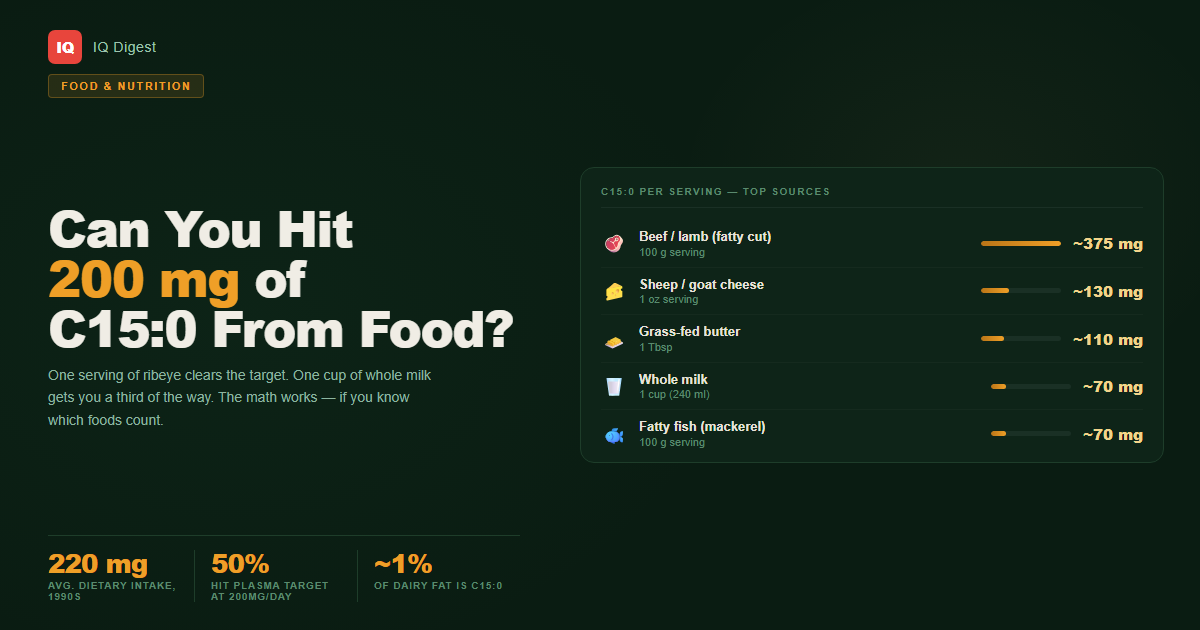
The highest per-serving sources, based on published ranges: fatty beef or lamb (~375 mg per 100 g), sheep or goat cheese (~130 mg per oz), grass-fed butter (~110 mg per tablespoon), aged cheddar (~90 mg per oz), full-fat yogurt (~85 mg per three-quarter cup), whole milk (~70 mg per cup).
The Skim-Dairy Problem
C15:0 lives entirely in the fat fraction. A cup of skim milk has almost none. The single most effective dietary lever for C15:0 is switching from low-fat to full-fat dairy — not adding more servings of the wrong version. This point matters more than grass-fed vs. conventional in most cases.
Does Grass-Fed Actually Matter?
The common assumption — including the ~1.3x multiplier baked into most C15:0 calculators — is that grass-fed dairy meaningfully outperforms conventional. A 2017 study measuring 54 Dutch retail butters by gas chromatography tells a more nuanced story.
Conventional butter averaged 1.16% C15:0 of total fatty acids, grass-fed averaged 1.19%, and organic averaged 1.25%. Organic vs. conventional was statistically significant (p = 0.001); the practical difference was small. The reason: Dutch conventional dairy cows have high pasture access even in "conventional" operations. US feedlot-finished cattle may show a larger gap. But the data suggests the popular ~1.3x rule overstates the real difference — probably closer to 1.05–1.10x for dairy fat. Prefer full-fat over fat-free first; grass-fed is a modest additional win.
What a 200 mg Day Looks Like
The math actually works in favor of food — if you eat the right foods. A single 100 g serving of fatty beef or lamb clears 200 mg on its own at roughly 375 mg. A tablespoon of grass-fed butter (~110 mg) plus an ounce of aged cheese (~90 mg) plus a three-quarter cup of full-fat yogurt (~85 mg) totals around 285 mg — entirely from dairy.
A 1990s female population averaged approximately 220 mg/day in a company-affiliated analysis. The wide standard deviation (±100 mg) is telling: a meaningful fraction were well below 120 mg/day, and that's in an era of higher dairy-fat consumption than today.
How Solid Is the 200 mg Target?
This is where the story gets interesting. The 200 mg figure is treated as established fact in most C15:0 coverage, but the evidence behind it is thinner than that framing implies.
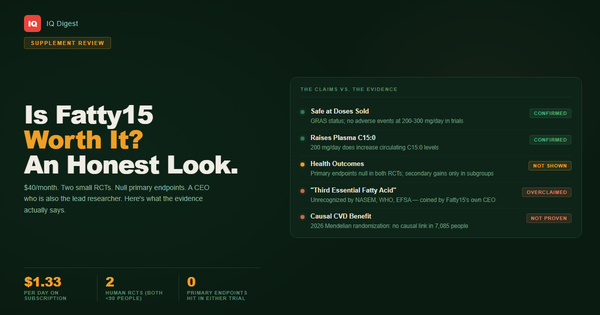
The pharmacokinetic study most often cited to justify the target actually modeled doses of 19–56 mg — far below 200 mg. A single-dose study (company-affiliated) showed 200 mg produces circulating concentrations of ~5 µg/mL, which became the stated threshold.
A 2025 independent RCT (n = 30, 12 weeks) tested 200 mg/day supplementation against placebo. Result: only 10 of 20 supplemented participants (50%) actually reached the ≥5 µg/mL threshold. Half didn't get there despite daily supplementation. Whether the miss reflects variable absorption, body weight, baseline diet, or genetics is unknown.
If 50% of people can't hit the target plasma level with a measured 200 mg supplement, the prospects for consistently reaching it via diet — where actual intake varies day to day — are harder to predict. The 200 mg target is a reasonable benchmark, not a precision prescription.
The Biomarker Question
Independent of whether you can reach 200 mg from food, there is a more fundamental question: does hitting that target actually matter for health outcomes?
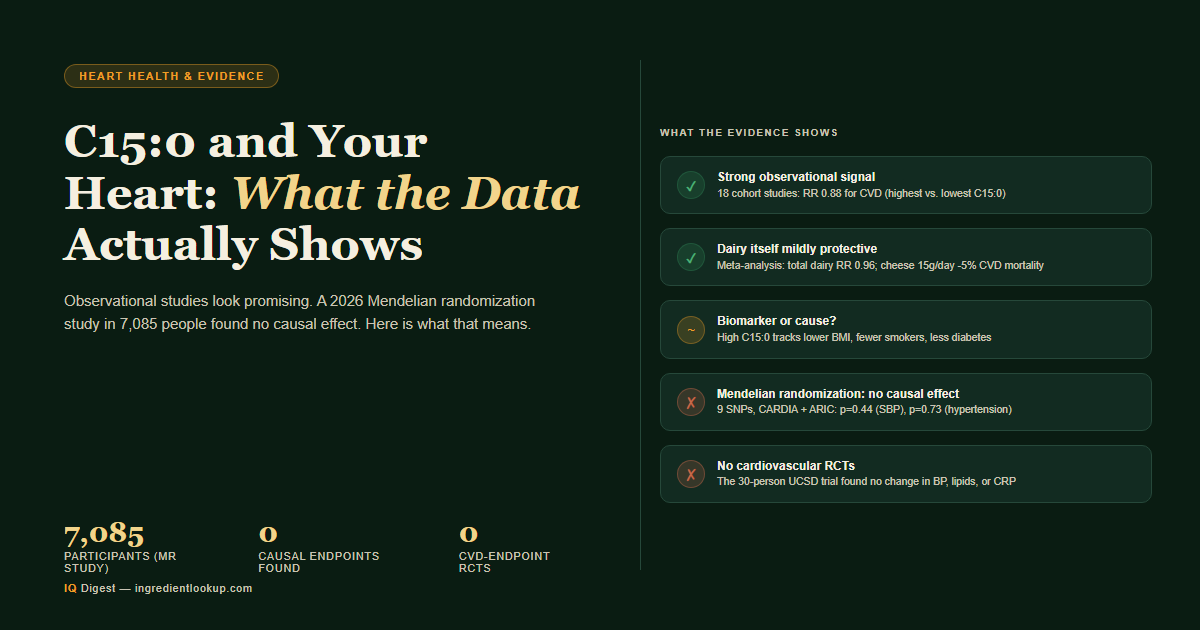
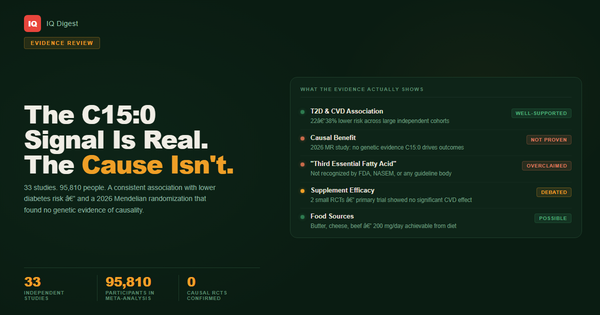
A 2026 Mendelian randomization analysis of the CARDIA and ARIC cohorts — roughly 7,085 U.S. adults — found no significant association between plasma C15:0 and incident cardiovascular disease in either cohort, and no causal effect of C15:0 on blood pressure, heart rate, or hypertension. The authors concluded that C15:0 functions as a biomarker of cardiometabolic health, not a causative agent of the outcomes associated with it.
That doesn't make full-fat dairy bad. It means the evidence for eating full-fat dairy is solid; the evidence that C15:0 specifically is the active ingredient is not.
Food vs. Supplement
Food-only is achievable if you eat fatty ruminant meat or significant full-fat dairy daily. The practical challenge is consistency — food C15:0 intake swings substantially day to day, and processing reduces it (retail grassmilk averages ~28% less C15:0 than raw due to fat standardization during processing).
If your diet naturally includes full-fat dairy and fatty meat several times a week, you are likely getting meaningful C15:0 from food and the marginal benefit of supplementing is unclear. If you eat little to no dairy or red meat, no amount of fiber or fish will substitute — and supplementation is the cleaner path to consistent dosing.
Use the C15 Intake Calculator to estimate where your current diet lands against the 200 mg benchmark.
All C15:0 food values are midpoints of published ranges — actual content varies with animal diet, breed, processing, and storage. This article is general nutrition education, not medical or dietary advice.