C15:0 (Pentadecanoic Acid): What the Science Actually Says
C15:0 has a genuine observational signal across 33 studies and 95,810 people. A 2026 Mendelian randomization study found no causal evidence. Here is what the independent research actually shows.

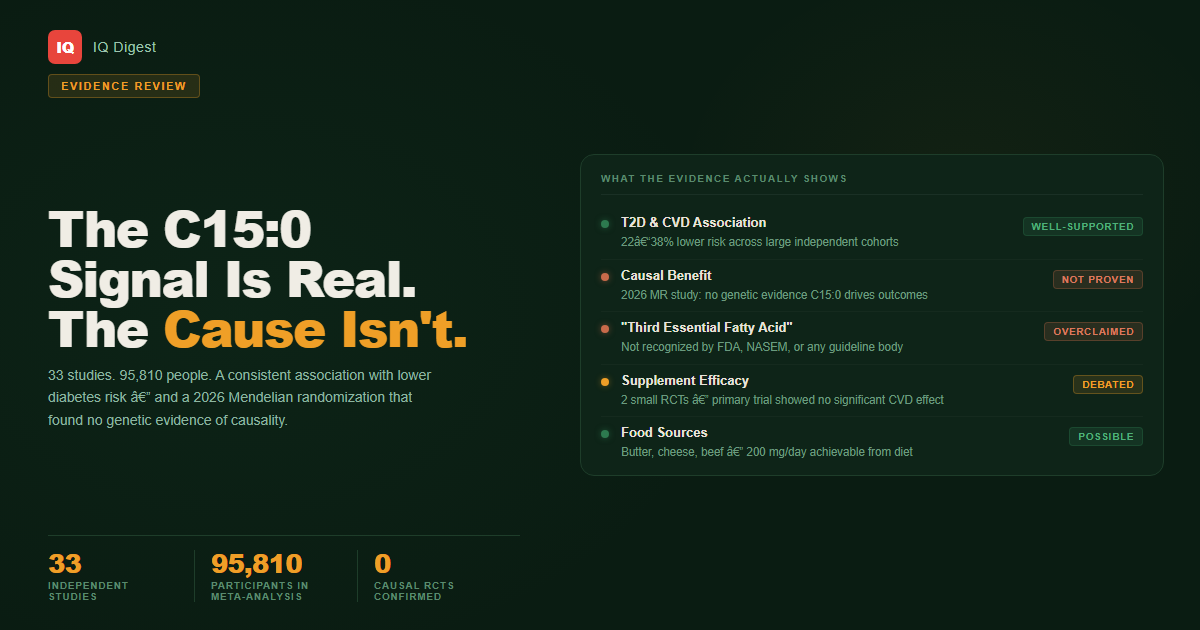
C15:0 — pentadecanoic acid — is an odd-chain saturated fatty acid found in dairy fat, grass-fed beef, and fatty fish. It has attracted serious scientific interest and aggressive supplement marketing. The observational evidence linking it to lower diabetes and metabolic disease risk is real. The causal evidence is not. Here is what independent research actually shows.
The Observational Signal Is Real
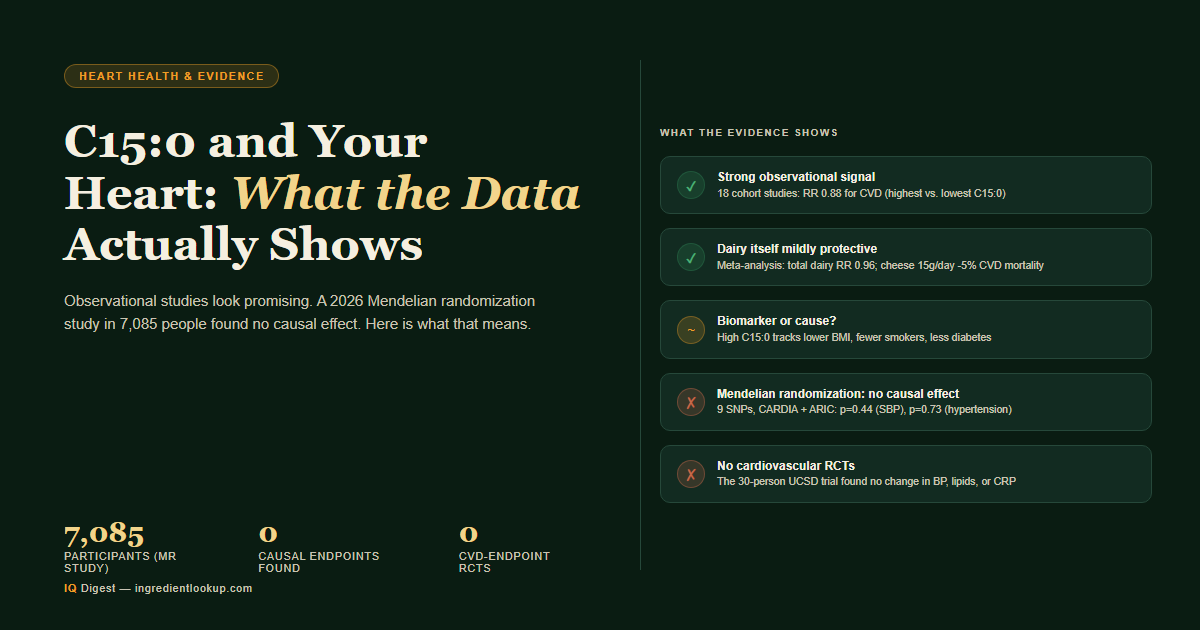
Multiple large independent cohort studies have found that people with higher circulating C15:0 levels have meaningfully lower rates of type 2 diabetes, cardiovascular markers, and metabolic syndrome. A 2020 meta-analysis of 33 prospective studies — 95,810 adults and 19,904 T2D cases — found a 22–38% lower T2D risk in the top versus bottom tertile of circulating C15:0. A 2025 European Heart Journal study found associations with lower ischemic heart disease risk in a Chinese cohort of 8,185 people. These associations appear consistently across independent research groups.
But Causality Has Not Been Established
Correlation is not causation — and in the case of C15:0, the association is almost certainly confounded. People with high circulating C15:0 also tend to eat more full-fat dairy, exercise more, smoke less, and have higher socioeconomic status. A 2026 Mendelian randomization analysis of the CARDIA and ARIC cohorts — roughly 7,085 U.S. adults — found no genetic evidence that C15:0 causes cardiovascular benefit. The authors explicitly concluded that C15:0 functions as a biomarker of cardiometabolic health rather than a biologically active cardiovascular protectant.
Mendelian randomization uses genetic variants as natural experiments — people born with genes that slightly raise C15:0 versus those who don't. If C15:0 caused cardiovascular benefit, the genetic-high group should show better outcomes regardless of diet. It didn't. This is the strongest observational tool for establishing causality short of a large RCT.
The "Essential Fatty Acid" Claim Is Overclaimed
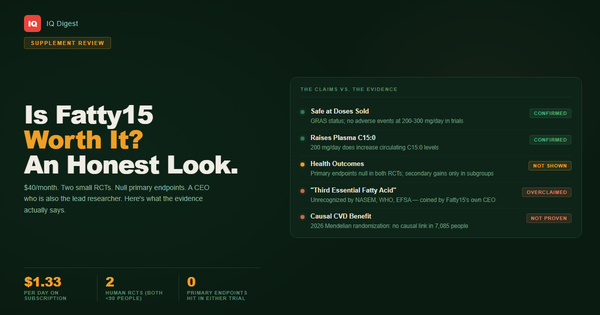
Fatty15 markets C15:0 as the "third essential fatty acid" — alongside omega-3 and omega-6. This framing is not recognized by the National Academies of Science, Engineering, and Medicine, the FDA, or any independent dietary guideline body. Essentiality has two criteria: that the body cannot produce the nutrient in meaningful amounts (plausible for C15:0), and that it is required for healthy physiological function (not established). OmegaQuant — a clinical fatty-acid testing lab with no stake in C15:0 supplements — identifies the second criterion as "where the controversy lies." A 2024 academic review calls it a "controversial essentiality."
The Conflict of Interest Problem
The majority of the clinically bold C15:0 research was authored or co-authored by Dr. Stephanie Venn-Watson — simultaneously the lead researcher, CEO of Seraphina Therapeutics, and co-founder of Fatty15. She holds patents on C15:0 applications licensed to her own company. The "3x better than omega-3s" claim traces to a 2022 PLOS ONE in-vitro cell study comparing C15:0 to EPA alone — not to the full omega-3 system, not in humans, and not independently replicated. The "Cellular Fragility Syndrome" and "1 in 3 deficient" framings are marketing language, not clinical diagnoses.
What the Human Trials Actually Show
As of mid-2026, only two randomized controlled trials of C15:0 supplementation exist. The primary Fatty15 human trial enrolled 30 participants aged 18 to 25 over 12 weeks and showed no significant cardiovascular changes on primary endpoints. The Center for Science in the Public Interest reviewed the evidence and concluded clinical benefit claims are not supported. No guideline from the American Heart Association, American College of Cardiology, or American Diabetes Association recommends C15:0 supplementation. The supplement is considered safe at doses sold — but safety is not efficacy.
Can You Get Enough from Food?
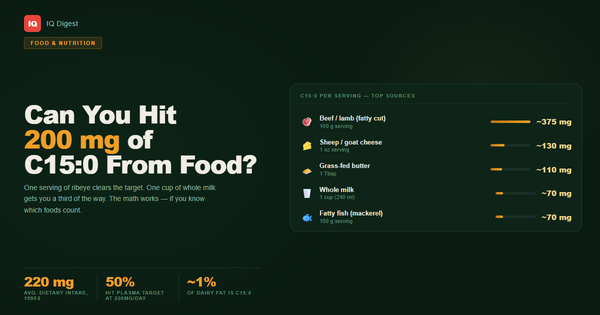
C15:0 lives almost entirely in dairy fat, grass-fed ruminants, and fatty fish. A tablespoon of grass-fed butter delivers roughly 90–130 mg. An ounce of aged cheese delivers 50–130 mg. A 100g serving of fatty beef delivers 300–450 mg. Whether diet alone reaches the commonly cited 200 mg/day research midpoint depends heavily on full-fat dairy consumption. C15:0 lives in the fat — skim and low-fat dairy has almost none. Use the C15 IQ Calculator to estimate your personal intake from food. All food values are estimates with meaningful ranges; no per-serving figure should be read as a precise lab measurement.
Sources: CARDIA/ARIC Mendelian Randomization 2026 | T2D Meta-analysis, 33 studies | European Journal of Preventive Cardiology 2025 | CSPI — Is Fatty15 Worth the Hype? | OmegaQuant — What Is C15?