Is Fatty15 Worth It? An Honest Review
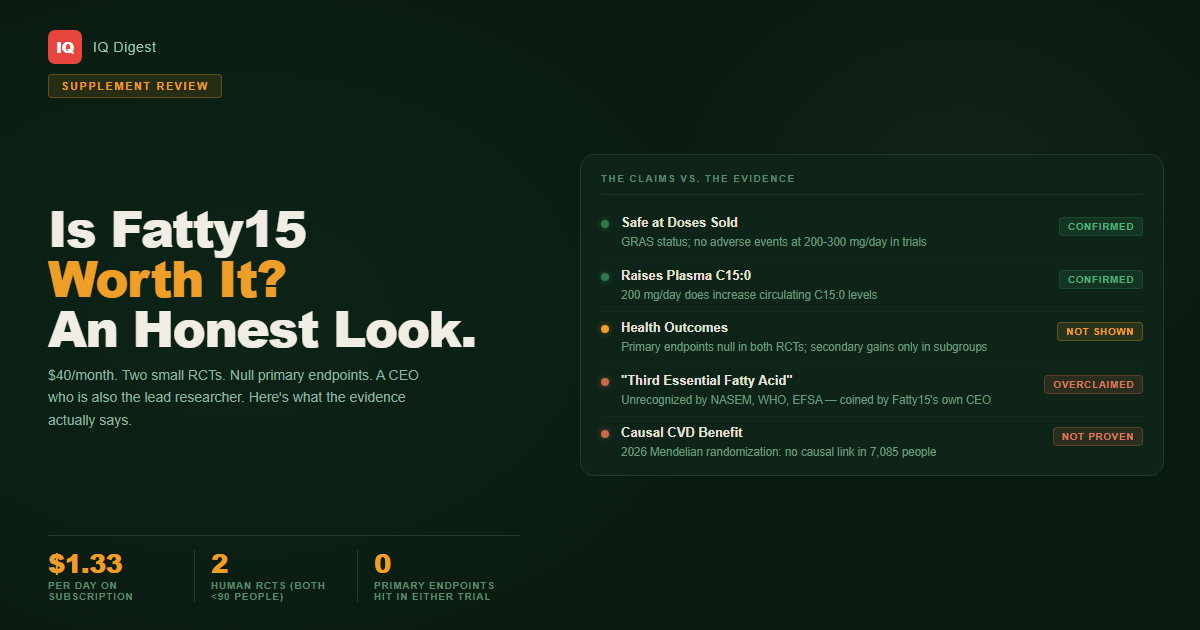
Fatty15 costs $40/month and its marketing claims run well ahead of the evidence. Two small RCTs, null primary endpoints, and a CEO who is also the lead researcher. Here's an honest look at what the science actually supports.

If you've searched "is Fatty15 worth it?" you've probably landed on pages written by people who haven't read the actual clinical trials. This one has. The short answer: Fatty15 is safe, does what it says on the label, and its marketing dramatically overstates what the science supports. Whether it's worth $40 a month depends on who you are.
What You're Paying For
A 90-day supply on subscription costs $119.95 -- about $1.33 per day or $40 per month. Without a subscription it's $149.95 for the same supply. Each capsule contains 200 mg of FA15 (pentadecanoic acid, C15:0), a pure form of the odd-chain saturated fatty acid found naturally in dairy fat and fatty ruminant meat.
The supplement is GRAS (generally recognized as safe) and no adverse events at the doses sold have been reported in clinical trials. On safety, there is nothing to argue about.
The Conflict of Interest You Should Know About
Before evaluating the health claims, you need to understand who is making them. Dr. Stephanie Venn-Watson is simultaneously the lead researcher on virtually all foundational C15:0 science, the co-founder of Seraphina Therapeutics (which owns patents on C15:0 applications), and the CEO of Fatty15. The company's own CEO is the scientist whose papers established that C15:0 is an "essential fatty acid" that most people are deficient in.
The terms "Cellular Fragility Syndrome" and "third essential fatty acid" -- two of the biggest claims on the Fatty15 website -- appear in peer-reviewed literature almost exclusively in papers co-authored by Venn-Watson through Seraphina Therapeutics. No independent nutrition guideline body -- not NASEM, not WHO, not EFSA, not the NHS -- has reviewed or endorsed either designation. These are not established clinical diagnoses. They are marketing concepts created by the company selling the product.
What the Two Human Trials Actually Found
As of mid-2026, two randomized controlled trials of C15:0 supplementation in humans exist.
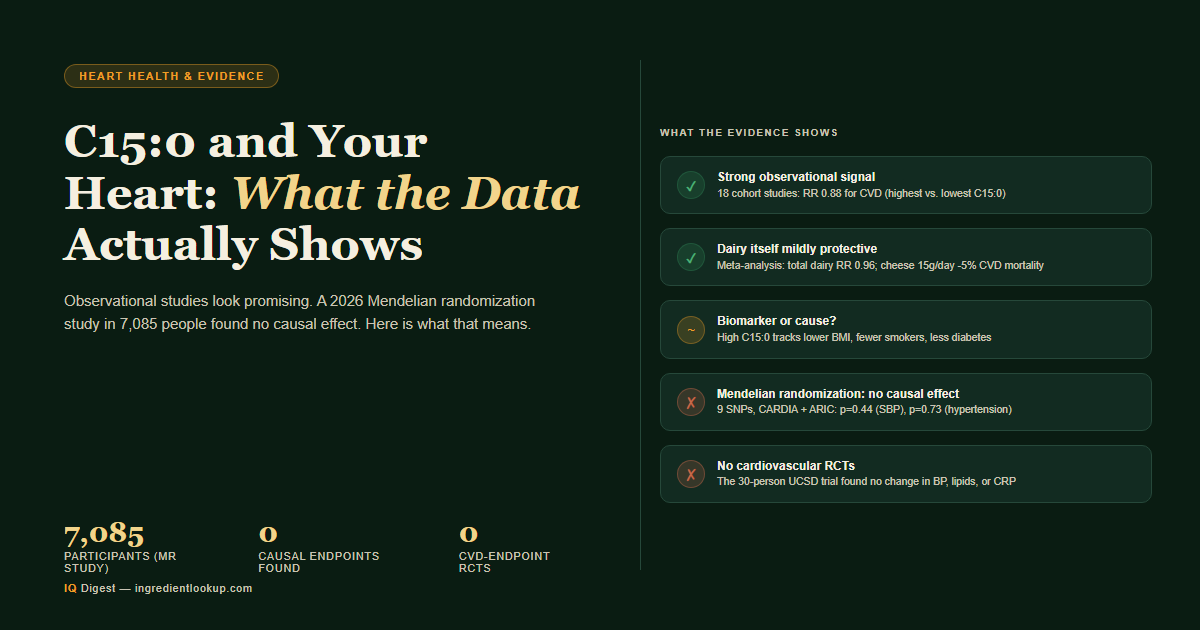
Trial 1 (n=30, 12 weeks, UCSD): The primary Fatty15 human trial enrolled 30 adults with overweight or obesity -- 20 receiving 200 mg/day C15:0 and 10 placebo. The supplement was provided by Seraphina Therapeutics. Result: no statistically significant differences on any primary endpoint -- body weight, waist circumference, total cholesterol, LDL, blood glucose, or inflammatory markers. The trial did find improvements in liver enzymes (ALT and AST) and hemoglobin in a post-hoc subgroup analysis of participants whose plasma C15:0 actually reached the target threshold of 5 micrograms per milliliter. But that subgroup analysis was not the pre-specified primary outcome, and the trial was substantially underpowered by standard clinical norms.
Trial 2 -- TANGO (n=88, 12 weeks, Singapore/Copenhagen): An independent trial in 88 Chinese women with non-alcoholic fatty liver disease compared an adapted Mediterranean diet plus C15:0 supplementation against Mediterranean diet alone. Authors declared no conflicts of interest. Result: liver fat reduction was 33% in the supplement group versus 30% with diet alone -- a clinically negligible difference. The only meaningful between-group finding was a modest LDL reduction and a small increase in a beneficial gut bacterium (Bifidobacterium adolescentis). The trial cannot be generalized beyond the specific NAFLD population studied.
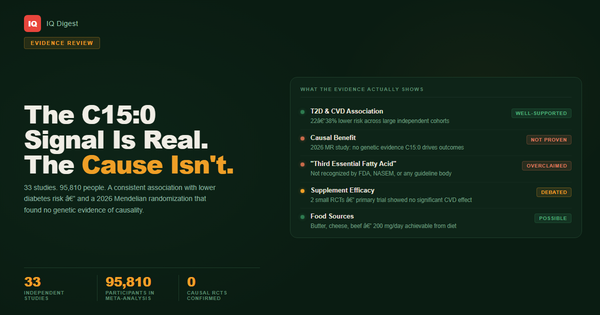
To put this in context: two trials, 118 participants combined, 12 weeks each, null primary endpoints in both. This is the sum total of human interventional evidence for Fatty15 as of 2026. The supplement may have real effects that these small, short trials couldn't detect -- but the "proven" framing on the product page is not supported by the current evidence base.
The 200 mg Target: Built on Rat Data
Fatty15 frequently cites 200 mg/day as the dose needed to reach optimal circulating C15:0 levels. What they don't prominently mention: the pharmacokinetic data underlying that target comes from a study in 6 male Sprague-Dawley rats, authored by Venn-Watson at Seraphina Therapeutics. No independent human pharmacokinetic trial has validated this threshold.
The one independent RCT that tested 200 mg/day in humans (the UCSD trial) found that participants' responses varied substantially -- not all achieved the target plasma level even with daily supplementation.
What Independent Science Says
The strongest independent evidence on C15:0 comes from a 2026 Mendelian randomization study published in Frontiers in Nutrition, conducted by researchers at the University of Minnesota with no declared conflicts of interest. They analyzed data from two large U.S. cohorts -- CARDIA (n=3,196) and ARIC (n=3,889) -- and found no causal effect of C15:0 on systolic blood pressure, diastolic blood pressure, resting heart rate, hypertension risk, or incident cardiovascular disease.
Mendelian randomization uses genetic variants as natural experiments: people with genes that slightly raise C15:0 levels are compared against those who don't. If C15:0 caused cardiovascular benefit, the genetic-high group should show better outcomes regardless of diet. They didn't. The authors concluded C15:0 "may act as a biomarker of cardiometabolic health" -- meaning it tracks healthy dietary patterns like full-fat dairy consumption, rather than actively causing the health outcomes associated with those patterns.
The Center for Science in the Public Interest reviewed Fatty15 and reached a similar conclusion: clinical benefit claims are not supported by the current evidence.
Fatty15 vs. Full-Fat Dairy
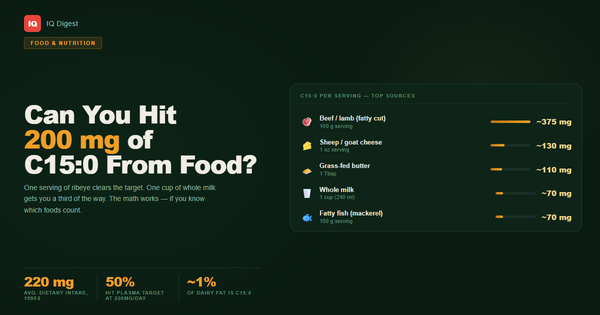
A tablespoon of grass-fed butter contains roughly 90-130 mg of C15:0. An ounce of aged cheese delivers 50-130 mg. A 100g serving of fatty beef clears 200 mg on its own. If you already eat full-fat dairy or fatty ruminant meat regularly, you are very likely getting meaningful C15:0 from food -- and if C15:0 is primarily a biomarker of healthy dietary patterns rather than an active agent, then eating those foods captures whatever benefit the biomarker is tracking anyway.
For $40 per month, you could buy a significant amount of quality full-fat dairy. The food route also delivers everything else that comes with dairy and meat (protein, fat-soluble vitamins, conjugated linoleic acid) rather than a single isolated fatty acid whose causal role hasn't been established.
Who Fatty15 Might Actually Make Sense For
The case for Fatty15 is strongest if you: (1) avoid dairy and red meat for medical, ethical, or dietary reasons and want consistent C15:0 intake; (2) have confirmed very low circulating C15:0 and a clinician has recommended supplementation; or (3) want to support the ongoing research by participating as a paying user of the product.
The case is weakest if you: eat a diet that naturally includes full-fat dairy or fatty meat several times a week; are primarily motivated by the cardiovascular or longevity marketing claims; or are on a tight budget and comparing this to other evidence-supported interventions like omega-3s, vitamin D, or exercise.
The Bottom Line
Fatty15 is a safe, legitimate supplement that does raise circulating C15:0. It is not a scam. But its marketing -- "third essential fatty acid," "Cellular Fragility Syndrome," "proven benefits" -- runs well ahead of what two small, short, largely null clinical trials can support. The foundational science comes overwhelmingly from a researcher who is also the company's CEO, and the strongest independent causal evidence (Mendelian randomization in 7,000+ people) finds no cardiovascular benefit.
If you eat full-fat dairy, skip it. If you don't eat dairy or red meat and want consistent C15:0, it's a reasonable option -- the 30-day trial kit is the lowest-commitment way to test it. If you're somewhere in the middle, use the C15 Intake Calculator to see where your diet actually lands -- you may already be getting more than you think.
Disclosure: This page contains affiliate links. If you purchase Fatty15 through our links, we may earn a commission at no extra cost to you. This does not influence our editorial assessment. Sources: CARDIA/ARIC Mendelian Randomization (Frontiers in Nutrition, 2026) | Primary Fatty15 RCT (PMC, 2025) | TANGO RCT (PubMed, 2023) | Venn-Watson et al., Scientific Reports (2020) | CSPI: Is Fatty15 Worth the Hype?