Sold Out: Why the Government Is Finally Admitting What We've Been Saying

For years, the answer to "why does this ingredient concern you?" was: because the research suggests it should, and because other countries have already acted.
The EU banned over 1,400 cosmetic chemicals the US permits. The EU requires warning labels on synthetic food dyes that the FDA still considers safe. The EU restricted parabens, formaldehyde releasers, and oxybenzone while American consumers kept buying them in products that said "safe" on the label.
The standard response from American regulators: not enough evidence. Not enough evidence to act. More studies needed.
That calculus is changing.
What Just Happened
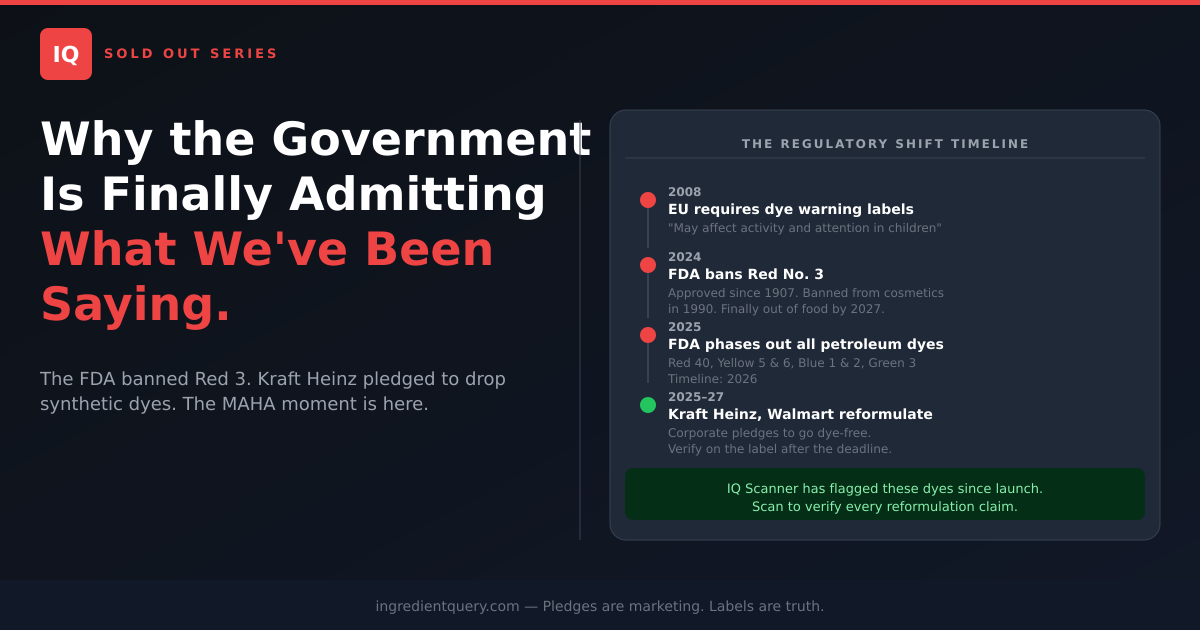
In January 2024, the FDA banned Red No. 3 — a synthetic dye that had been approved for use in food since 1907. The ban takes effect in 2027 for food manufacturers and 2028 for ingested drugs.
Red 3 was already banned from cosmetics and externally applied drugs in 1990 — because the FDA's own research found it caused thyroid cancer in male rats. It remained in food for another 34 years, used in maraschino cherries, cocktail cherries, canned fruit, and candy.
IQ Scanner has flagged Red 3 since launch.
Then in April 2025, the FDA announced it was working to phase out all petroleum-based synthetic dyes from the food supply — Red 40, Yellow 5, Yellow 6, Blue 1, Blue 2, Green 3, and others. The same dyes that have required warning labels in the EU ("may have an adverse effect on activity and attention in children") since 2008.
The FDA's timeline for the US: 2026.
The Corporate Pivot
When regulators move, corporations follow — or get ahead of the wave.
Kraft Heinz announced in June 2025 that it would remove all synthetic dyes from its US product portfolio by 2027. This is the company that makes Kool-Aid, Capri Sun, and a large portion of the processed food Americans buy in bulk.
Walmart announced it would eliminate synthetic dyes from all private-label products — meaning its Great Value and Marketside brands would go dye-free.
PepsiCo, which owns Gatorade, has reformulated sports drinks to remove synthetic dyes after years of pressure from pediatricians and parent groups.
This is the MAHA moment — Make America Healthy Again — the political shorthand for a shift in consumer and regulatory appetite toward what Europe has required for decades.
The Vindication Problem
Here is the uncomfortable part of this story:
The ingredients now being banned or phased out weren't secret. The concerns weren't new. The research linking Red 40 to hyperactivity in children was published in peer-reviewed journals in the early 2000s. The EU acted on it in 2008. American parents concerned about it were, for years, told they were being alarmist.
Now Kraft Heinz is reformulating. The FDA is banning. Walmart is committing to clean labels.
That's not a victory lap moment — it's a question about what was knowable and when. The ingredients that are being removed in 2027 were concerning in 2007. The consumers who were flagging them were correct. The regulatory process that took 20 years to catch up was not.
How to Verify Reformulation Claims
"We removed the synthetic dyes" is a claim. Labels tell the truth.
When a brand announces it's going clean — removing dyes, dropping preservatives, sourcing organically — the only way to verify it is to check the ingredient list after the announced change date.
Announcements are marketing. The ingredient list is the contract.
Use IQ Scanner to scan any reformulated product. If the dyes are gone, they won't appear. If they're still there under a different name — caramel color, "natural" flavor that contains synthetic components, a dye listed under its E-number rather than its common name — the scan will surface it.
The regulatory shift is real. The follow-through from individual brands may be slower, partial, or inconsistent. The only way to know is to check.
What to Watch
The next 18 months will produce a wave of "clean label" announcements from brands that have spent decades using the ingredients now under pressure. Some will be genuine. Some will be partial — removing the most visible offenders while keeping others. Some will involve reformulating for the US while maintaining the original formula for international markets where regulations differ.
Brands to audit as reformulation deadlines approach:
- Kraft Heinz products — 2027 dye-free pledge: verify on the label after 2027
- Walmart Great Value — private label reformulation ongoing
- Gatorade — already reformulated; verify the current label
- Any product with "new formula" or "improved recipe" — could mean cleaner, could mean cheaper
The Bigger Picture
The MAHA moment doesn't mean the problem is solved. It means the problem has finally become politically visible.
The same corporations now pledging to remove synthetic dyes spent decades lobbying against restrictions on them. The reformulations happening in 2026–2027 are happening because regulatory pressure and consumer pressure reached a tipping point — not because the research changed.
The research was there. The consumers flagging it were right. The slow regulatory machinery has now started to move.
What doesn't change: the ingredient list is still the only reliable source of truth about what's in a product. Pledges, announcements, and "clean label" certifications are claims.
Scan the label. Read what's actually there.
→ Scan a label and see what flags
This is the fourth post in the Sold Out series. Start from the beginning: You Trusted the Logo. You Should Have Read the Label.