Sold Out: You Trusted the Logo. You Should Have Read the Label.

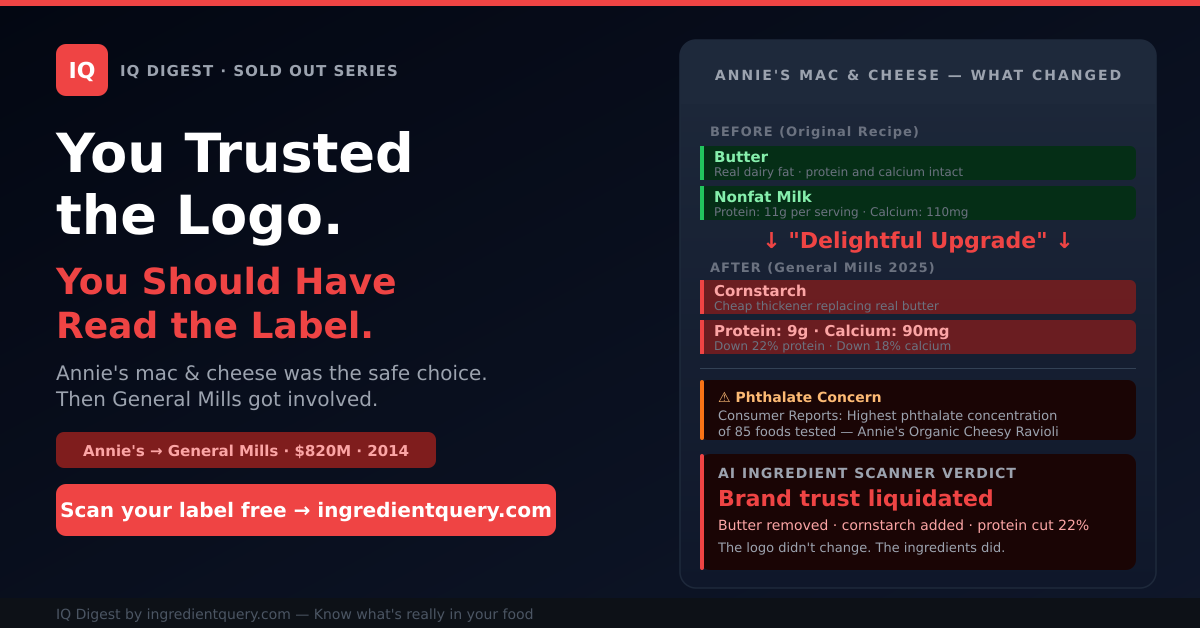
There's a box of Annie's Shells & White Cheddar in millions of American pantries right now. Parents buy it because they trust it. The bunny logo. The word "organic." The implication that this is the good mac and cheese — the one you feel okay about feeding your kids.
In 2025, General Mills announced what they called a "delightful upgrade" to Annie's mac & cheese.
It was not a delight.
What actually changed:
The reformulated recipe quietly removed butter and nonfat milk — two ingredients that made Annie's Annie's — and replaced them with cornstarch. A cheap thickener. The kind of ingredient you'd expect in a store-brand product, not an $820 million acquisition built on clean-ingredient credibility.
The numbers tell the story:
- Protein dropped 22% — from 11g to 9g per serving
- Calcium fell from 110mg to 90mg
- Cornstarch replaced real dairy fat
And that's before we get to the phthalates. A Consumer Reports investigation found that Annie's Organic Cheesy Ravioli had the highest concentration of phthalates — hormone-disrupting plasticizers — of 85 food products tested. These aren't added ingredients. They migrate into food from manufacturing equipment and packaging. But they accumulate. And they're worth knowing about.
Consumers noticed. A Change.org petition went up. The internet went sideways. And General Mills responded with the corporate equivalent of a shrug.
The acquisition math
General Mills bought Annie's in 2014 for $820 million. That's not a purchase made out of love for organic pasta. It's a financial transaction with a required return.
The playbook is always the same:
- Buy the brand that health-conscious consumers trust
- Inherit the premium price point that trust commands
- Quietly reduce the cost of goods — cheaper ingredients, cheaper sourcing, cheaper manufacturing
- Keep the logo, the bunny, the "organic" claim where it still applies
- Pocket the margin difference
Most consumers never re-read a label they've trusted for years. That's not naivety — it's rational. You made the decision once. You don't expect the product to change without announcement.
But it does. Quietly. A reformulation here. A supply chain switch there.
Annie's isn't alone
When Kellogg's bought Kashi in 2000 for $32 million, Kashi was a clean whole-grain brand with no GMOs. By 2012, a grocer in Rhode Island discovered GMO ingredients in the products and pulled them from shelves. Kashi was later sued for labeling products "all natural" while they contained hexane-processed soy — a petroleum solvent — and synthetic vitamins.
Kashi's U.S. retail sales fell 35% between 2010 and 2014. Loyal customers didn't forgive it.
When Dean Foods acquired Silk soymilk in 2002, Silk was organic. By 2009, Dean quietly switched from organic to conventional soybeans — same packaging, same brand, different product. Most consumers never noticed. The word "organic" just... disappeared from the label. The organic soybeans cost $7.25 more per bushel. Dean pocketed that difference.
The pattern is consistent enough to have a name: ingredient betrayal.
The logo isn't the product
Here's what this comes down to: the logo is a shortcut. It's a trust signal that lets you skip the ingredient list. And that shortcut is exactly what food corporations are monetizing when they acquire brands like Annie's.
They're not buying pasta. They're buying your habit of not reading the label.
The ingredient list never lies. The packaging often does. "Organic" can still mean cornstarch. "Natural" can mean synthetic vitamins. "All natural" can mean hexane-processed. The front of the package is marketing. The back is the truth.
IQ Scanner was built for exactly this. Photograph the ingredient list — not the front of the box, the actual label — and find out what you're actually buying. Not what the logo promises. What the ingredients confirm.
Scan Annie's this week. Compare it to what you thought you were buying.
The bunny is still there. The butter isn't.
Next in the Sold Out series: How Big Food buys your trust — then sells it back cheaper. The acquisition playbook, the Kashi GMO scandal, and why the brand in your cart probably isn't who you think it is.