The Dirty Dozen: Artificial Dyes Hidden in "Healthy" Foods

You're standing in the grocery store holding a bottle of "strawberry" flavored water. The label says natural flavors. The liquid is a vivid, almost glowing pink.
No strawberry was harmed in the making of that color.
What you're looking at is Red 40 — a synthetic dye made from petroleum distillates — doing the job that actual fruit was supposed to do. And it's not just in candy and soda anymore. It's in your yogurt, your salad dressing, your kids' vitamins, and products proudly labeled "all natural."
Here's everything the label isn't telling you.
Where Artificial Dyes Come From
Every certified artificial food dye in the U.S. starts life as a coal tar or petroleum derivative. They're synthesized in chemical plants, purified, and then certified batch-by-batch by the FDA — which is where the "FD&C" prefix comes from (Food, Drug & Cosmetic).
The dyes currently approved for use in U.S. food:
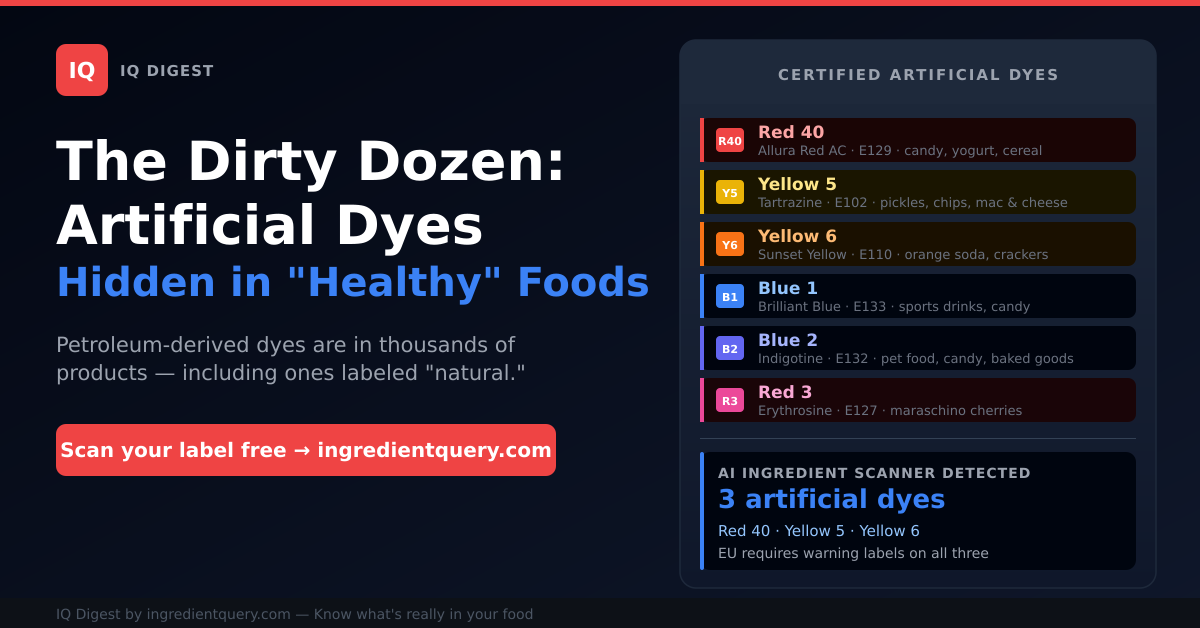
| Dye | Also Called | Common Uses |
|---|---|---|
| Red 40 | Allura Red AC, E129 | Candy, yogurt, cereals, sports drinks |
| Yellow 5 | Tartrazine, E102 | Pickles, chips, mac & cheese, soda |
| Yellow 6 | Sunset Yellow, E110 | Orange soda, crackers, baked goods |
| Blue 1 | Brilliant Blue, E133 | Sports drinks, candy, ice cream |
| Blue 2 | Indigotine, E132 | Pet food, candy, baked goods |
| Green 3 | Fast Green, E143 | Canned peas, seafood, mint products |
| Red 3 | Erythrosine, E127 | Maraschino cherries, fruit cocktail |
Three more — Citrus Red 2, Orange B, and FD&C Violet 1 — are approved but rarely used. Together these make up the core of what the food industry uses to make processed food look like it contains real ingredients.
The Study That Changed Everything in Europe
In 2007, researchers at the University of Southampton published a landmark study in The Lancet. They found that a mix of six artificial dyes — Red 40, Yellow 5, Yellow 6, and three others — combined with the preservative sodium benzoate caused measurable increases in hyperactivity in children aged 3 and 8–9.
The response was swift — in Europe.
The EU required warning labels on any food containing the "Southampton Six": "may have an adverse effect on activity and attention in children." Most manufacturers quietly reformulated their products for the European market, replacing synthetic dyes with beet juice, paprika extract, and turmeric.
The same companies sell the dye-free version in Europe and the dye version in the United States.
The FDA reviewed the same study and concluded more research was needed. That was 2011. The dyes are still in the food supply.
Red 3: The One the FDA Tried to Ban
Red 3 — the bright cherry-red dye in maraschino cherries and fruit cocktail — has a complicated history.
In 1990, the FDA actually banned Red 3 in cosmetics and externally applied drugs after studies showed it caused thyroid tumors in male rats at high doses. The FDA's own scientists concluded the dye was a carcinogen under the Delaney Clause, which prohibits adding carcinogens to food.
But Red 3 stayed in food. Why? The ban on cosmetics was implemented, but the food ban got tangled in regulatory procedure for decades.
In January 2025, the FDA finally revoked authorization for Red 3 in food — 35 years after banning it in cosmetics. Food manufacturers have until 2027 to reformulate.
Until then: it's still legal. It's still in products on shelves right now.
The "Healthy" Foods That Contain Them
This is where it gets uncomfortable. These aren't just candy bars and soda. Dyes show up in:
- Flavored yogurts — "strawberry" and "cherry" varieties frequently contain Red 40
- Pickles and relish — Yellow 5 is common, used to maintain a bright green color
- Salmon and fish — Canthaxanthin and astaxanthin (synthetic versions) are used to turn farmed salmon pink
- Maraschino cherries — Red 3 and Red 40, even in "gourmet" brands
- Children's vitamins — Flintstones, gummy vitamins, nearly all chewables
- Sports drinks — Gatorade, Powerade, Liquid IV all use multiple dyes
- Packaged mac & cheese — Yellow 5 and Yellow 6 create that iconic orange
- "Fruit" snacks — even ones with fruit in the name often contain zero real fruit pigment
The pattern: anywhere a food needs to look like it contains something it doesn't, a dye is doing the work.
How to Spot Them on a Label
Certified artificial dyes must be declared by name on U.S. ingredient labels — this is one area where labeling law actually works for you. Look for:
- FD&C Red No. 40 (or just "Red 40")
- FD&C Yellow No. 5 (must also be declared for allergy reasons — Yellow 5 causes reactions in some people, particularly those sensitive to aspirin)
- FD&C Yellow No. 6
- FD&C Blue No. 1 or Blue No. 2
- Red 3, Green 3
Vague terms like "artificial color" or "color added" can also indicate synthetic dyes but may hide which specific ones. If you need to know exactly what's in there, you need to look for the numbered names.
What to Look For Instead
When manufacturers reformulate without synthetic dyes, they typically use:
- Beet juice / beet powder — reds and pinks
- Turmeric — yellows and oranges
- Spirulina extract — blues and greens
- Paprika extract — oranges and reds
- Annatto — yellows and oranges (note: annatto can trigger reactions in some people)
- Carrot juice — oranges
These appear on labels as their actual names — beet juice concentrate, turmeric (for color) — which makes them easy to identify and research.
The Bottom Line
Artificial dyes serve one purpose: making food look better than it is. They add no nutrition, no flavor, and no preservation. Their only job is cosmetic — to make your brain think the product contains more real ingredients than it does.
The EU figured this out in 2008. Whether or not you're concerned about the hyperactivity research, the logic is simple: if a dye-free version of the same product exists for European consumers, you can reasonably ask why the dyed version exists for you.
The answer is that bright colors increase sales. Not that they're necessary. Not that they're safe. That they sell.
Scan your next label. You might be surprised what's making your food look that good.
Scan any food label free at ingredientquery.com — our AI flags every artificial dye instantly.