The Seed Oils in Everything — Processed with Hexane, Often GMO

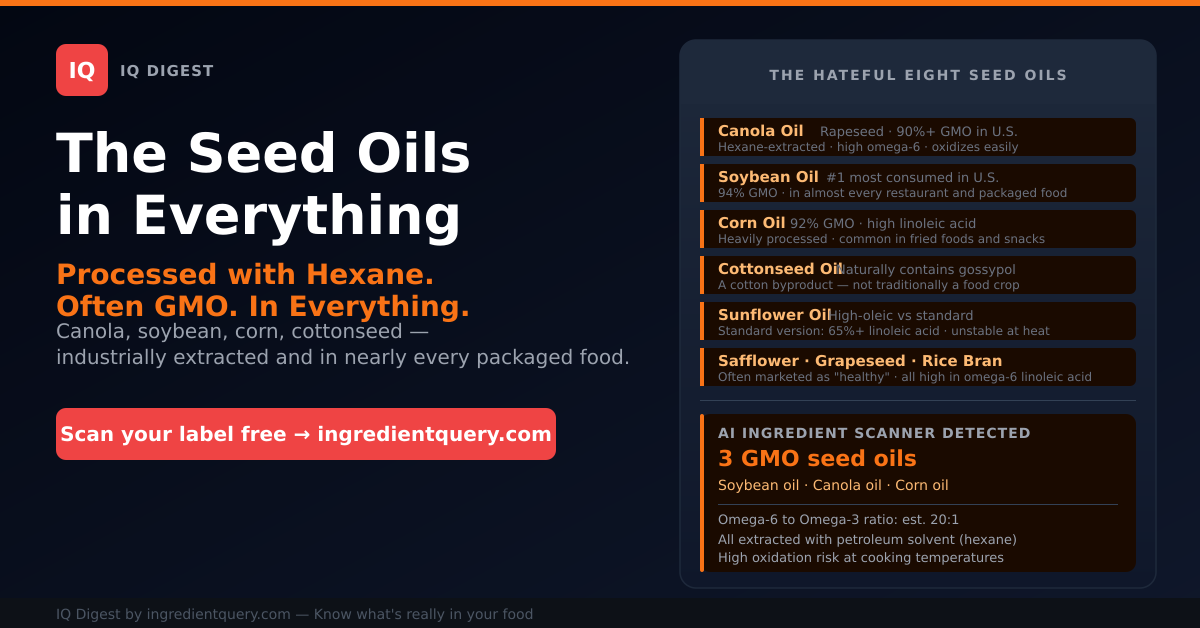
Open any packaged food in your kitchen. Flip it over. Somewhere in that ingredient list you will almost certainly find one of these: soybean oil, canola oil, corn oil, sunflower oil, safflower oil, cottonseed oil, grapeseed oil, or rice bran oil.
These are seed oils — sometimes called "vegetable oils," a marketing term that makes industrial petroleum-extracted fat sound like something you'd find at a farmers market.
They are in your crackers, your salad dressing, your protein bar, your bread, your chips, your frozen meals, your fast food, and your restaurant meals. Soybean oil alone accounts for roughly 40% of all edible oil consumed in the United States.
Here's what they are, how they're made, and why they've become one of the most debated ingredients in modern nutrition.
What Seed Oils Are (And Aren't)
The term "vegetable oil" is deliberately vague. It sounds like olive oil or avocado oil — traditional fats pressed from whole foods. Seed oils are something different.
They are oils extracted from the seeds of crops — rapeseed (canola), soybeans, corn kernels, cottonseeds, sunflower seeds — that are not naturally oily enough to be cold-pressed efficiently. Getting meaningful quantities of oil out of them requires industrial processing.
Traditional fats used throughout most of human history — butter, lard, tallow, olive oil, coconut oil — were either animal fats or pressed from naturally fatty fruits. Seed oils are largely a 20th-century invention, made economically viable by industrial chemistry.
How Seed Oils Are Made
This is the part that most people don't know.
Step 1 — Seed preparation. Seeds are cleaned, dehulled, and crushed or flaked to begin breaking down cell walls.
Step 2 — Hexane extraction. The crushed seeds are bathed in hexane — a petroleum-derived solvent classified as a neurotoxin and air pollutant. Hexane dissolves the oil out of the seed material far more efficiently than mechanical pressing alone, increasing yield significantly. The oil-hexane mixture is then heated to evaporate the hexane.
Step 3 — Degumming. Phospholipids and other compounds are removed using water or acid.
Step 4 — Refining (RBD). The oil is Refined, Bleached, and Deodorized:
- Refining: treated with caustic soda (sodium hydroxide) to remove free fatty acids
- Bleaching: passed through clay filters to remove pigments and oxidation products
- Deodorizing: steam-distilled at extremely high temperatures (240–270°C / 464–518°F) to remove the foul odor that naturally results from the previous processing steps
The final product is a neutral-colored, neutral-smelling, shelf-stable oil. It bears little resemblance to the raw seed it came from.
Trace hexane residues remain in the oil after processing. The FDA does not require testing or limits for hexane residue in refined oils.
The GMO Connection
Most seed oils sold in the United States come from genetically modified crops:
| Oil | Estimated GMO Rate (U.S.) |
|---|---|
| Soybean oil | ~94% |
| Canola oil | ~90% |
| Corn oil | ~92% |
| Cottonseed oil | ~94% |
| Sugarbeet (used in some oil blends) | ~99% |
The GMO modifications are primarily for herbicide tolerance (Roundup Ready varieties) and insect resistance. The modifications affect the crop plant — the oil extracted from the seed contains no DNA and no proteins, meaning the oil itself is chemically identical whether from GMO or non-GMO seeds.
However: herbicide-tolerant crops are designed to survive heavy glyphosate application. This means GMO soy, canola, and corn are typically sprayed with significantly more glyphosate than conventional crops. Glyphosate residues have been detected in refined seed oils in independent testing, though at levels the EPA considers below their safety threshold.
If you want to avoid GMO-sourced seed oils, look for USDA Organic labeling — organic certification prohibits GMO crops — or products that specifically state non-GMO.
The Omega-6 Problem
The most substantive nutritional concern about seed oils isn't the processing or the GMO sourcing — it's their fatty acid composition.
Seed oils are extremely high in omega-6 polyunsaturated fatty acids, specifically linoleic acid. This is a fat your body cannot produce itself and must consume — it is an essential fatty acid. The issue is the ratio.
Omega-6 and omega-3 fatty acids compete for the same enzymes in the body. When omega-6 intake is very high relative to omega-3, this competition creates an imbalance that researchers have linked to increased inflammatory signaling.
Historically, humans consumed omega-6 and omega-3 in a ratio of roughly 1:1 to 4:1. The modern American diet — heavily featuring seed oils — produces ratios estimated at 15:1 to 20:1 or higher.
Linoleic acid content of common oils:
- Safflower oil: ~75%
- Sunflower oil (standard): ~65%
- Corn oil: ~57%
- Soybean oil: ~51%
- Cottonseed oil: ~50%
- Canola oil: ~21% (lower, but still significant at consumption volumes)
Compare to olive oil (~10%), coconut oil (~2%), and butter (~2%).
The Heat Problem
Polyunsaturated fats are chemically unstable at high temperatures. When seed oils are heated to cooking temperatures — especially in restaurant deep fryers or on high-heat stovetops — the fatty acid chains oxidize, forming compounds including:
- Aldehydes — toxic compounds including 4-hydroxynonenal (4-HNE), which has been linked to neurodegenerative disease in animal studies
- Trans fats — small amounts form even without partial hydrogenation
- Lipid peroxides — oxidized fats that can damage cells
Restaurant fryers typically run at 175–190°C (350–375°F) and reuse oil repeatedly over days. The oxidation compounds accumulate with each heating cycle.
This is why the same seed oil that is merely high in omega-6 when fresh becomes significantly more concerning after being used for restaurant-style frying.
Cottonseed Oil: The Odd One Out
Among seed oils, cottonseed deserves special mention.
Cotton is not traditionally a food crop — it's a textile crop. Cottonseed oil is a byproduct of cotton processing. The raw cottonseed contains gossypol, a naturally occurring toxin that causes fertility problems and organ damage. Gossypol is removed during refining.
The reason cottonseed oil matters: it was one of the first widely used seed oils in American food, popularized in the early 1900s as a cheap byproduct of the booming cotton industry. Crisco, when it launched in 1911, was made entirely from cottonseed oil. The modern American relationship with seed oils started with a textile crop byproduct.
What to Look For on Labels
Seed oils are listed by name on ingredient labels. Watch for:
- Soybean oil (or "vegetable oil" — often soy)
- Canola oil
- Corn oil
- Cottonseed oil
- Sunflower oil
- Safflower oil
- Grapeseed oil
- Rice bran oil
- "Vegetable oil" (generic — almost always soy or canola or a blend)
- "Partially hydrogenated" any of the above (trans fat — still appears in some products)
The cleanest labels use olive oil, avocado oil, coconut oil, or butter — fats with very different fatty acid profiles and processing histories.
The easiest swap in your kitchen: Primal Kitchen built their entire brand on replacing seed oils with avocado oil — their mayo, dressings, and cooking oils use cold-pressed avocado oil instead of canola or soybean. It's the most direct like-for-like swap in the condiment aisle. Use code IQ$PK89F10 for 10% off at primalkitchen.com.

The Other Side of the Debate
This topic is genuinely contested in nutrition science, and intellectual honesty requires acknowledging that.
Major health organizations including the American Heart Association continue to recommend replacing saturated fats with polyunsaturated fats — including seed oils — based on decades of research associating saturated fat intake with cardiovascular disease risk.
The counterargument from researchers like Dr. Paul Saladino, Dr. Chris Knobbe, and others is that the omega-6 research, oxidation data, and the historical context of seed oil introduction alongside rising chronic disease rates represent a causal relationship that mainstream guidance has failed to account for.
The honest position: the seed oil debate is not settled. What is not debated is the processing method (hexane extraction, high-temperature deodorization), the GMO prevalence, and the dramatic increase in linoleic acid consumption over the past century.
A Tool Worth Knowing: Seed Oil Scout
If you want to avoid seed oils when eating out — not just at home — there's an app built specifically for that.
Seed Oil Scout (@seedoilscout on Instagram) is a community-driven map of restaurant ingredients and sourcing, with over 2 million downloads and 45,000 restaurants mapped across the country. It shows you which restaurants cook with natural fats like beef tallow, butter, lard, and avocado oil instead of canola and soybean oil — rated 4.8 stars with 23,000+ reviews.
Available on iOS and Android. Think of it as Yelp for tallow-fried food.
The Bottom Line
You don't need to take a position on the full scientific debate to make a reasonable observation: seed oils are industrially processed products that didn't exist in meaningful quantities in the human diet until the 20th century, they are now in virtually everything, and most people consume far more of them than they realize or intend to.
Whether you choose to avoid them is a personal decision. But knowing they're there — in your crackers, your restaurant food, your "healthy" salad dressing — requires reading labels. They're rarely the first thing people check.
Scan any food label free at ingredientquery.com — our AI flags GMO seed oils and estimates your omega-6 exposure instantly.