What "Natural Flavor" Actually Means (It's Not What You Think)

Pick up any packaged food. Flip it over. Scan the ingredient list.
Somewhere near the bottom, in small print, you'll almost certainly find it: natural flavor. Or natural flavors. Two words that tell you almost nothing — and are designed to.
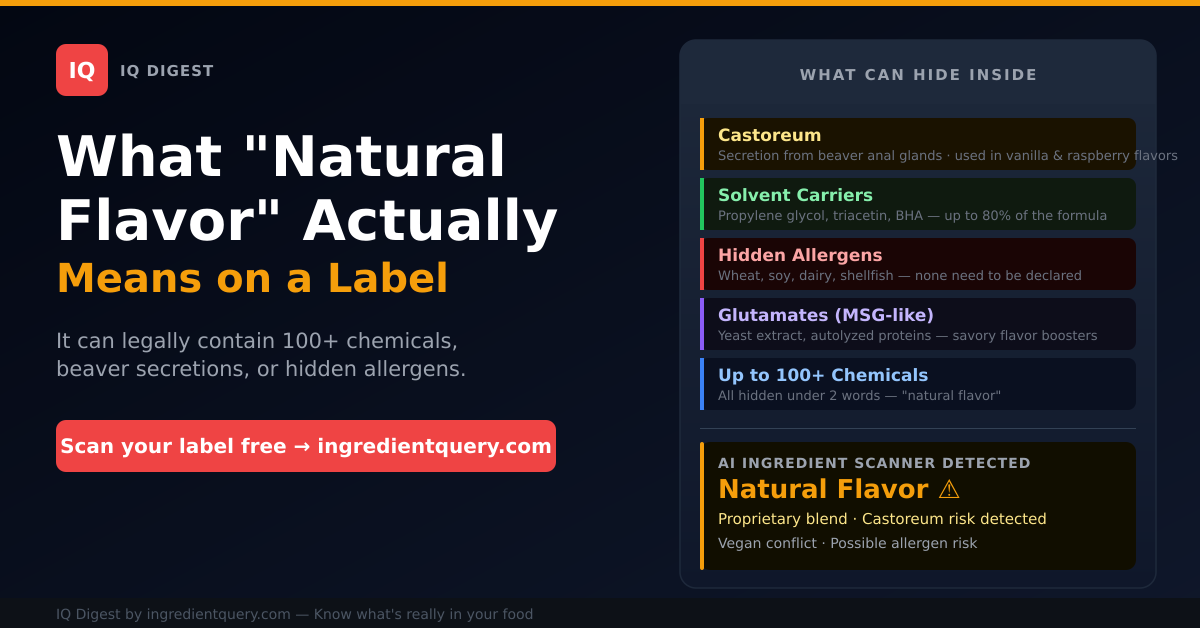
"Natural flavor" is the fourth most common ingredient listed on U.S. food labels. It's in your protein bar, your sparkling water, your salad dressing, your baby food. And under FDA rules, those two words can legally conceal a formula containing dozens — sometimes over a hundred — individual chemical compounds, none of which the manufacturer has to disclose.
Here's what's actually in there.
The FDA Definition (It's Looser Than You Think)
The FDA defines "natural flavor" as:
"The essential oil, oleoresin, essence or extractive, protein hydrolysate, distillate, or any product of roasting, heating or enzymolysis, which contains the flavoring constituents derived from a spice, fruit or fruit juice, vegetable or vegetable juice, edible yeast, herb, bark, bud, root, leaf or similar plant material, meat, seafood, poultry, eggs, dairy products, or fermentation products thereof."
Translation: it has to start from something natural. What happens after that is up to the manufacturer.
A flavor chemist — they're called flavorists — can take a natural starting material and transform it through dozens of chemical processes, add solvents, carriers, preservatives, and emulsifiers, and the final product still qualifies as "natural flavor" as long as the flavor compound itself came from a natural source.
The flavor formula is protected as a trade secret. You have no legal right to know what's in it.
What Can Actually Be in "Natural Flavor"
Castoreum
This is the one that stops people cold.
Castoreum is a yellowish, butter-like secretion produced by the castor sacs of beavers — glands located near the base of the tail. It has a warm, musky scent that blends easily with vanilla and fruit notes. The FDA classifies it as GRAS (Generally Recognized As Safe).
It has been used in vanilla, raspberry, and strawberry-flavored products. Manufacturers are not required to disclose it — it qualifies as "natural flavor" because it comes from an animal.
In practice, castoreum is expensive and relatively rare in commercial food production today, having been largely replaced by cheaper synthetic alternatives. But it is legal, it has been used, and it would never appear on a label.
Solvent Carriers
The actual flavor compound is typically only a small fraction of what's in the flavor formula. The rest is carrier solvents — chemicals that dilute and stabilize the flavor so it can be uniformly distributed through a food product.
Common carriers include:
- Propylene glycol (also used in antifreeze and vaping fluid)
- Triacetin (a plasticizer)
- BHA (butylated hydroxyanisole) — a preservative added to the flavor formula itself, not to the food directly, so it doesn't need to appear separately on the label
These carriers can account for up to 80% of the flavor formula by weight. None of them are disclosed.
Hidden Allergens
This is the most practically dangerous aspect of "natural flavor."
The FDA requires disclosure of the eight major allergens — milk, eggs, fish, shellfish, tree nuts, peanuts, wheat, and soybeans — when they're added directly as ingredients. But when allergens enter a food through a natural flavor formula, the rules are murkier.
A "natural flavor" derived from shellfish, dairy, or wheat does not always require explicit allergen disclosure. People with food allergies who scan labels for the major allergens can miss exposures entirely because they're embedded in a flavor formula.
Glutamates and Flavor Enhancers
"Natural flavor" is also frequently used to introduce glutamates — compounds that activate the same taste receptors as MSG — without triggering consumer resistance to MSG itself.
Ingredients like yeast extract, autolyzed yeast, hydrolyzed vegetable protein, and similar compounds are high in free glutamates and commonly appear inside flavor formulas. Consumers who avoid MSG for sensitivity reasons may be getting functionally similar compounds through "natural flavor" without knowing it.
"Natural" vs. "Artificial": The Distinction Barely Matters
Here's a fact that surprises most people: natural and artificial flavors can be chemically identical.
The compound amyl acetate gives bananas their flavor. It can be extracted from bananas (natural flavor) or synthesized in a lab from acetic acid and amyl alcohol (artificial flavor). The final molecule — C₇H₁₄O₂ — is exactly the same. Your body cannot tell the difference.
The only distinction is the origin of the starting material, not the safety, purity, or simplicity of the final compound.
In many cases, artificial flavors are actually simpler formulas with fewer individual compounds than their natural equivalents. "Natural vanilla flavor" can contain over 200 chemical components. Pure vanillin (the artificial version) is one compound.
Why It's Listed This Way
Food companies use "natural flavor" for three reasons:
1. Trade secret protection. Flavor formulas are proprietary. A competitor reverse-engineering your product's flavor profile is a real business threat. Broad labeling protects the formula.
2. Flexibility. If you list specific flavor compounds, you have to reformulate the label every time your flavor supplier changes the formula. "Natural flavor" covers the whole category.
3. Marketing. "Natural flavor" tests better with consumers than "artificial flavor" or a list of chemical compound names. The label is a marketing tool as much as an information tool.
What to Look For Instead
Products that use specific natural sources — and label them — are telling you more:
- "Vanilla extract" instead of "natural flavor"
- "Lemon juice concentrate" instead of "natural lemon flavor"
- "Turmeric (for color and flavor)" instead of "natural flavor"
- "Rosemary extract" — specific, transparent
If a product lists the actual ingredient doing the flavoring work, that manufacturer is choosing transparency. If it says "natural flavor" and nothing else, the formula is hidden by design.
One brand that gets this right: Primal Kitchen built their entire brand on replacing seed oils with avocado oil — their mayo, dressings, and cooking oils use cold-pressed avocado oil instead of canola or soybean. Their avocado oil mayo lists "organic vinegar" and "lemon juice concentrate" where a conventional mayo would list "natural flavor" and call it a day. Use code IQ$PK89F10 for 10% off at primalkitchen.com.

The Vegan Problem
Most vegans already know to watch for gelatin, whey, and casein. Far fewer know that "natural flavor" is a common route for animal-derived compounds to enter otherwise plant-based products.
Chicken flavor, beef flavor, fish flavor, castoreum, dairy derivatives — all can appear under "natural flavor." Products labeled vegan are supposed to ensure their flavor suppliers verify no animal-derived compounds are used, but this verification is voluntary and inconsistently enforced.
If you eat vegan for ethical reasons and "natural flavor" appears on an ingredient list, you cannot be certain what you're consuming without contacting the manufacturer directly.
The Bottom Line
"Natural flavor" is not a lie — but it's not a meaningful truth either. It's a legal term of art that the food industry uses to protect proprietary formulas while presenting a friendly face to consumers.
What the two words don't tell you:
- How many compounds are in the formula
- What solvents or carriers are present
- Whether allergens are involved
- Whether any animal-derived compounds are used
- What preservatives were added to the formula itself
The next time you see "natural flavor" on a label, you now know it's a locked door — and what might be on the other side.
Scan any food label free at ingredientquery.com — our AI flags natural flavor and checks for castoreum risk, vegan conflicts, and allergen concerns.