Your Vanilla Flavor Might Come From a Beaver's Glands

This is one of those food facts that sounds like an internet hoax until you look it up.
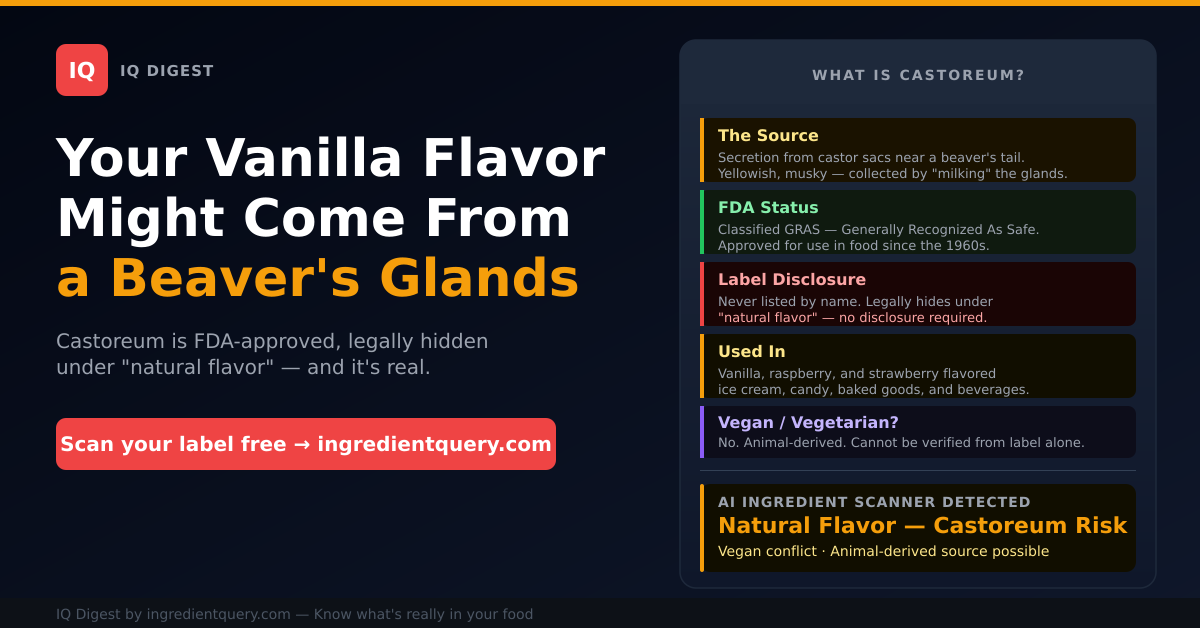
There is a substance called castoreum. It is produced by beavers. It smells remarkably like vanilla. The FDA has approved it for use in food since the 1960s. And if it ends up in your ice cream, yogurt, or candy, the label will say "natural flavor" — nothing more.
Here's the full story.
What Castoreum Actually Is
Beavers have two castor sacs — small glandular pouches located between the pelvis and the base of the tail. These sacs produce castoreum, a yellowish, waxy, intensely aromatic secretion that beavers use primarily for scent marking their territory.
The scent profile of castoreum is complex: musky, leathery, and warm — with unmistakable vanilla and raspberry undertones. This is because beavers' castor sacs chemically process the bark, leaves, and plants they eat, concentrating plant phenols (including vanillin, the same compound responsible for vanilla's flavor) into the secretion.
To harvest castoreum commercially, the castor sacs are removed from the beaver — either after trapping or from animals raised for fur — and "milked" or dried. The resulting extract is then processed and sold to food flavoring companies.
It is, unambiguously, an animal secretion. And it is legal, GRAS-classified, and invisible on ingredient labels.
How Long Has This Been in Food?
Castoreum has been used in perfumery for centuries — its musky warmth made it valuable in luxury fragrances long before synthetic alternatives existed. Its use in food flavoring dates back at least to the early 20th century.
The FDA formally classified it as GRAS in 1965 as part of a broad review of flavoring substances. The approval covers its use in vanilla, fruit, and other flavor applications.
Food manufacturers are not required to list castoreum by name. Under FDA labeling rules, any ingredient that functions as a flavor — regardless of its origin — can be declared as "natural flavor" on an ingredient label, provided it derives from a natural source. Beaver glands qualify as natural.
How Common Is It Really?
Here is where the story gets more nuanced — and where some food journalists oversimplify.
Castoreum is genuine and legal, but it is not particularly common in modern commercial food production. The reasons are practical:
It's expensive. Harvesting castoreum requires trapping or raising beavers, which is significantly more costly than simply synthesizing vanillin from wood pulp (which is how most "vanilla flavor" is actually made today) or using cheaper plant-based flavor compounds.
Supply is limited. Beaver populations are not farmed at industrial scale. The annual production of castoreum globally is estimated at a few hundred kilograms — a tiny fraction of the vanilla flavoring market.
Synthetic alternatives are abundant. Vanillin synthesized from guaiacol (a petrochemical derivative) or from lignin (a wood byproduct) is chemically identical to natural vanillin and costs a fraction of the price.
So the honest answer is: castoreum has been used, is still legal to use, and could be in products labeled "natural vanilla flavor" today — but it is probably not in most mass-market vanilla ice cream or candy. The economics strongly favor synthetic vanillin.
What is genuinely true: you cannot know from a label whether castoreum was used. The label will say "natural flavor" in either case.
Why This Matters Beyond the Gross Factor
The castoreum story is compelling on its own merits, but it points to a larger structural problem with "natural flavor" labeling.
For vegans and vegetarians: Castoreum is animal-derived. Products that carry no other animal ingredients — no dairy, no eggs, no meat — and are marketed as vegan could theoretically contain castoreum in their flavor formula. There is no labeling requirement that would reveal this. Responsible manufacturers use flavor suppliers who certify their formulas as vegan, but this is voluntary and unverified at the label level.
For the general consumer: The FDA's definition of "natural" in food flavoring has nothing to do with whether the source would seem natural or acceptable to the average person. Beaver gland secretions are natural by the regulatory definition. So is castoreum from dried insects (carmine/cochineal for red color), secretions from civet cats (used in some fragrance compounds), and dozens of other animal-derived substances most consumers would be surprised to find in their food.
The label "natural flavor" is a legal category, not a consumer-friendly description.
Which Products Are Most Likely to Have Used Castoreum
Based on historical flavor industry usage, castoreum has appeared most often in:
- Vanilla-flavored products — ice cream, frozen yogurt, coffee creamer, baked goods
- Raspberry-flavored products — candy, beverages, yogurt, desserts
- Strawberry-flavored products — similar category
- Perfumes and personal care products — where it is more commonly used than in food
Products using "vanilla extract" (which must come from the vanilla bean) or "pure vanilla" are not using castoreum — the extract classification requires a specific botanical source. The risk is in products that say "vanilla flavor," "natural vanilla flavor," or simply "natural flavor" in a vanilla-flavored product.
How to Know If a Product Contains It
You cannot determine from the label alone. The options:
- Contact the manufacturer. Ask specifically: "Does your natural flavor contain any animal-derived compounds, including castoreum?" Manufacturers are not legally required to answer, but many will.
- Look for certified vegan products. Third-party vegan certification (Certified Vegan, The Vegan Society) requires manufacturers to verify with their flavor suppliers that no animal-derived compounds are used. This is the strongest assurance available.
- Choose products that name the actual flavoring. "Vanilla extract," "vanilla bean," "Madagascar vanilla" — these are specific, regulated terms that exclude castoreum.
- Scan the label. Our AI flags "natural flavor" and notes castoreum risk as a factor — so you know to ask the question.
The Bottom Line
Castoreum is real. It has been used in food. It could be in a product you bought this week. You would have no way to know.
This isn't a conspiracy — it's a labeling system that was designed to protect trade secrets, not to serve consumer transparency. The same two words that hide castoreum also hide propylene glycol, MSG-adjacent compounds, hidden allergens, and hundreds of synthetic chemical carriers.
The question "what is natural flavor?" has a legitimate answer. The answer is just not on the label.
Scan any food label free at ingredientquery.com — our AI flags natural flavor and checks for castoreum risk, vegan conflicts, and allergen concerns.